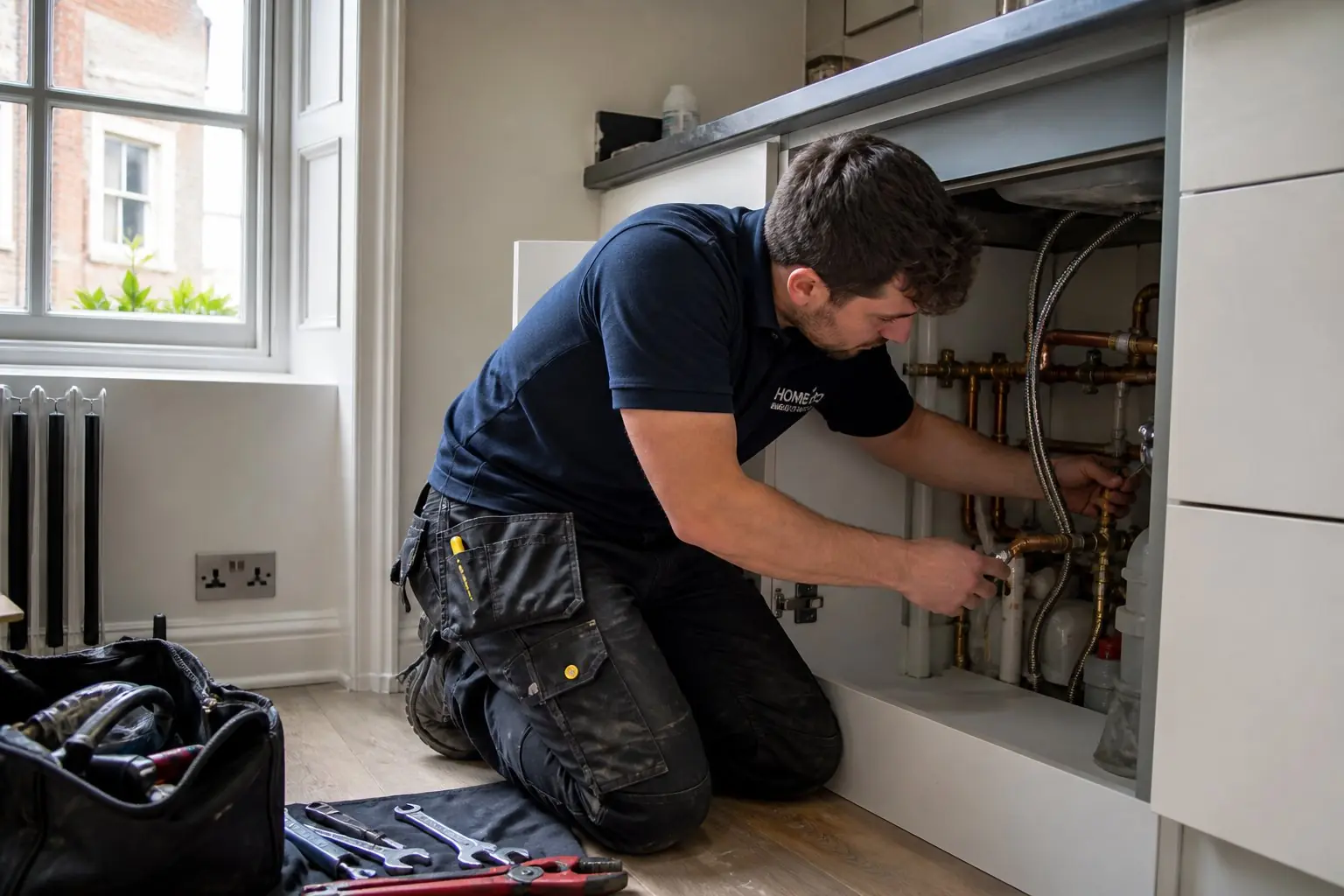
You can book a flight to Tokyo on your phone. You can have groceries delivered in eleven minutes. You can summon a car to your front door with three taps. But if your boiler dies on a Sunday evening, you're back to ringing strangers, hoping someone calls back, and bracing yourself for the £100 they'll charge just to come and tell you what's wrong.
Seven Services exists because that gap shouldn't exist anymore. The technology to fix it has been around for years. The platforms that fixed transportation, accommodation and food delivery all worked because they took the most painful step in the old way of doing things and made it free, fast and obvious. We've done the same thing for property maintenance. The painful step we removed: the diagnostic visit.
An Industry Stuck in 2005
Property services in the UK is a £30 billion-a-year industry that has somehow avoided being modernised. The supply side — qualified, hardworking tradespeople — is genuinely good. The demand side — homeowners, landlords, Airbnb hosts, business owners — has its hand up, ready to pay. The thing that's broken is the layer between them: how you find each other, how you trust each other, how you transact, how the work gets coordinated.
Talk to anyone in London about the industry and the same complaints surface. None of them are about the cost of good work — most people accept that good trades aren't cheap. They're structural:
- You can't tell who's good. Online reviews are gameable. Personal recommendations don't always cover the trade you need. Trade-association directories are a starting point, not an answer.
- Pricing is opaque until it isn't. A phone quote becomes an invoice with extra zeros. "We hit a complication on the day" covers a multitude of sins.
- You pay just to find out what's wrong. The diagnostic call-out — anywhere from £80 to £150 in London, more for evenings or weekends — is the £100 problem nobody wants to question. Half the time, the actual fix turns out to be something you could have done yourself if someone had just looked at it.
- Out-of-hours is a gamble. Something fails at 8pm on a Sunday and your options narrow to "ruinously expensive emergency call-out" or "wait until Monday and pray nothing gets worse."
- Multi-trade jobs become multi-headache jobs. A bathroom refurb might involve a plumber, an electrician, a tiler, a painter and a glazier. That's five separate sourcing exercises, five sets of phone tag, five different price negotiations.
The £100 Problem We Decided to Fix First
If you're going to rebuild an industry, you don't start with everything. You start with the friction point that everyone hates and nobody questions, because removing it is the change customers feel immediately.
For property services, that friction point is the diagnostic call-out. A boiler stops firing. A socket starts buzzing. A tap starts dripping in a way you can't quite locate. You don't know whether it's a five-minute fix or a £400 repair. Until a tradesperson is physically standing in your home, nobody can tell you. And to get a tradesperson physically standing in your home, you pay £80–£150 — sometimes more for evenings, weekends or emergency callouts. That fee gets paid whether or not any actual work happens. Half the time, the diagnosis turns out to be something the tradesperson could have helped you with over a five-minute video call, for free. The diagnostic visit is the friction tax of the entire industry.
So that's where Seven starts. Open the app, submit a request, and get a free video call with a vetted London tradesperson — usually within minutes. They look at the problem through your camera. You discuss it. You decide together whether you actually need a visit, or whether the fix is something simpler. If you do book the visit, the professional already knows what they're walking into and what to bring. The first conversation costs you nothing.
Why a Marketplace Platform, Not a Directory
The market has tried to solve the wider booking problem before, and mostly missed. Directory sites — Checkatrade, MyBuilder, Rated People — list trades, take a listing fee, and disappear from the transaction. The customer still has to do all the work: ring around, compare quotes, judge unverified reviews, manage the booking, chase the trader. The directory has no skin in whether you have a good experience.
That's the wrong model for a service this important. Booking a stranger to come into your home and rewire a circuit, or replumb a kitchen, isn't like ordering a takeaway. It needs more than a list. It needs vetting that's actually been done by humans. It needs a real conversation before a real commitment. It needs a single point of accountability when something goes sideways.
So Seven isn't a directory. It's a marketplace platform — the same model that fixed transportation (Uber), accommodation (Airbnb), takeaways (Deliveroo) and hundreds of other industries that used to be opaque, fragmented and unreliable. The pattern is consistent because the underlying logic is consistent: aggregate trusted supply, match it to verified demand, wrap a tech layer around the experience, and stand behind every transaction. Where Seven diverges from those platforms is the video-first step — because property work is the rare category where you genuinely benefit from talking to the professional before they show up.
How the Platform Actually Works
Two stages. The first is always free. The second only happens if you decide it's worth it.
Stage 1 — Free video consultation
Open the app. Choose your service category. Type a few keywords describing the problem. Enter your UK postcode. Tap Request a professional. The request goes out instantly to qualified providers in your area. The first one available accepts, and your phone rings — exactly like a FaceTime or WhatsApp call. You answer. You're in a live video call with a vetted London tradesperson, usually within minutes.
The call is free. There's no minimum spend, no booking commitment, no obligation. You can show the professional the problem with your camera, ask questions, get a real opinion. Inside the call, you've got a shared whiteboard and document-upload tools to make diagnosis easier. Either of you can end the call.
Stage 2 — On-site visit (optional)
By the end of the video call you'll know one of three things: the problem is something you can sort yourself with the professional's guidance (no further action needed), it's a real job that needs a visit (you've agreed pricing and a time on the call), or you'd like a second opinion (request another video consultation with someone else).
If you booked a visit, the professional travels to your address at the agreed time and completes the work. Payment is processed securely through the app after the job is done — your card details held by Stripe, not by Seven. (For a full screen-by-screen walkthrough, see our how the Seven Services app works article.)
More Than Homeowners
One of the things that surprised us early on: the platform serves at least six distinct audiences, and the same product solves a different problem for each of them. The booking flow is the same. The reason people use it isn't.
- Homeowners — the obvious use case. A leaky tap, a flickering light, a boiler that won't fire. The platform replaces "ask a friend who they used."
- Tenants — for the small stuff a landlord won't fix quickly enough, or for moving-in/moving-out work. Free diagnosis matters most here.
- Landlords — managing repairs across one property or twenty. The platform centralises sourcing, pricing and history so a portfolio's maintenance lives in one system. The video consultation is especially valuable when you're not at the property yourself — you can be on the call alongside your tenant.
- Airbnb hosts — the audience with the highest urgency in the city. Guest checks in at 4pm; the shower's not draining. Same-day or it's a refund situation. Video diagnosis means a real opinion within minutes, not a waiting game.
- Property managers — coordinating multi-property, multi-trade work for residential blocks or commercial sites. Volume + reliability + a single billing relationship.
- Busy professionals and small businesses — anyone whose time is more valuable than the hour spent ringing tradespeople.
The Trust Layer
The hardest part of building a platform like this isn't the booking flow or the matching logic. It's the trust layer — the work of making sure every professional on Seven actually deserves to be there. We do this manually, on purpose. Software can flag suspicious patterns; only a human can judge whether a tradesperson should be representing the platform.
Every professional goes through the same checks before they receive a single customer request:
- Identity verification and right-to-work confirmation
- Trade qualifications — Gas Safe registration for gas work, Part P / NICEIC for electrical, City & Guilds for plumbing and other trades
- Current public liability insurance
- A skills assessment relevant to their trade
Once they're on the platform, the verification doesn't stop. Customer ratings are reviewed on an ongoing basis after each completed job. Professionals whose ratings drop, or who pick up complaints, get paused while we look into it. The rating system is feedback to us, not just to other customers — and we act on it.
Eight Services, One Platform
The all-in-one model is core to the thesis. A property doesn't need just one trade — it needs whichever trade is relevant to whatever's broken this week. Splitting that across multiple platforms or contact lists is exactly the friction we're trying to remove.
Currently live on the platform:
- Plumbing — leaks, blockages, installations, full system work
- Electrical services — fault diagnosis, rewiring, consumer unit upgrades, lighting
- Boiler & heating — Gas Safe registered engineers, repair and service
- Handyman — the catch-all for the dozen small jobs nobody else will take
- Painting and decorating — interior and exterior, single rooms to whole properties
- Renovation and refurbishment — kitchens, bathrooms, full property refits
- Appliance installation and repairs — washing machines, ovens, integrated kitchen appliances
- Emergency property repairs — burst pipes, no heat, no power, lock-outs
What We're Working on Next
We're early. The platform launched in London because that's where the density makes a marketplace work — enough trades, enough customers, enough urgency to test every part of the model. London is the wedge, not the destination.
We're not going to pretend a roadmap is set in stone when it isn't, but the directions we care about most:
- Going deeper in London first — more trades per borough, faster match times, expanding the network of vetted professionals so video calls connect even faster
- Improving the in-app payment, scheduling and history tools — particularly for landlords and property managers who need cleaner records across multiple properties
- Eventually, taking the model beyond London once the playbook is properly proven
The long-term ambition is to become the default way property work gets booked in the UK — the way Uber became the default for getting somewhere. That's a high bar. We know it. Whether we get there will depend on whether the people using the platform today think it's worth telling their friends about.
Try It — The First Conversation Is Always Free
The thing about marketplaces is that they're hard to evaluate from the outside. The pitch always sounds plausible. The proof is in actually using it once. The best suggestion we can offer: download the app, submit a request for whatever's bugging you about your home, your rental, or your property right now — large or small — and see whether the experience matches what's described above. The video consultation is free, so the worst case is you've spent a few minutes finding out we're not as good as we say. The best case is you saved yourself a £100 callout.
And to make trying us properly low-stakes: new customers get 15% off their first booked job through the app — automatically applied at request.
Download the Seven Services App
Free video consultations with vetted London tradespeople. Pay only for work you decide to book. Available on iOS and Android.