London Airbnb hosts know that a single poor review can derail months of carefully built ratings. Heating failure consistently ranks as the fastest route to a one-star experience — a guest without hot water on a cold January morning in Hackney or a freezing flat in Islington will not be forgiving in their feedback. This article provides general information only and is not a substitute for advice from a qualified Gas Safe registered engineer. If you suspect a gas leak or carbon monoxide risk at any point, instruct guests to leave the property immediately and call the National Gas Emergency Service on 0800 111 999.
For London hosts, the challenge is compounded by distance: many operate their listings from across the city or from overseas, making a rapid physical response impossible. The good news is that the majority of boiler and heating faults that guests report are either diagnosable without a site visit or are resolvable without dispatching anyone at all — if you know what to look for.
Why Heating Failures Hit Airbnb Hosts Harder Than Standard Landlords
For a residential landlord, a boiler breakdown triggers inconvenience and legal obligation. For an Airbnb host, the consequences compound on a much shorter timescale. Paying guests on a three-night city break lose a significant portion of their trip to the disruption. Airbnb's guest protection policies allow refund requests when essential services fail, meaning a mid-booking heating outage can result in both a financial loss and a public one-star review appearing on your listing.
There is also an expectations gap that does not exist with long-term tenants. A tenant develops tolerance for a temperamental system over months and learns its quirks. An Airbnb guest arrives expecting every amenity to work exactly as described. In London's winter months — which extend from November through to March — the absence of heating and hot water is not a minor inconvenience. It is the defining failure of the stay.
A pattern frequently seen in London's inner-borough Airbnb stock is that many short-let properties occupy Victorian or Edwardian conversions in Hackney, Islington, and Haringey — and many of the combi boilers serving those individual flats are now 12–15 years old. These boilers are approaching the end of their reliable service life precisely as short-let hosting in those boroughs has grown. A host who bought and listed a flat five years ago without updating the heating system is now carrying a meaningful breakdown risk into every winter booking season.
For hosts managing multiple listings, a single heating failure also ripples outward: calendar management, future bookings, guest communications, and pricing all absorb the cost of a response that could have been avoided with proper preventive maintenance.
The Immediate Response When a Guest Reports No Heating or Hot Water
When a guest message arrives saying there is no heating or hot water, the instinct is to call a tradesperson immediately. In most cases, this is not the most effective first step. The majority of boiler faults that guests report in London flats fall into a small number of categories — and most of them either resolve with simple guest action or can be properly assessed remotely before anyone needs to travel to the property.
The first step is to establish precisely what the guest is experiencing. The questions that matter are:
- Is it no heating only, no hot water only, or both?
- Is the boiler display showing any error code, warning light, or fault indicator?
- What does the pressure gauge on the boiler read?
- Are any thermostats or smart heating controls set to an active schedule?
- Has anything changed in the property — a window left open, a thermostat adjusted, a switch tripped?
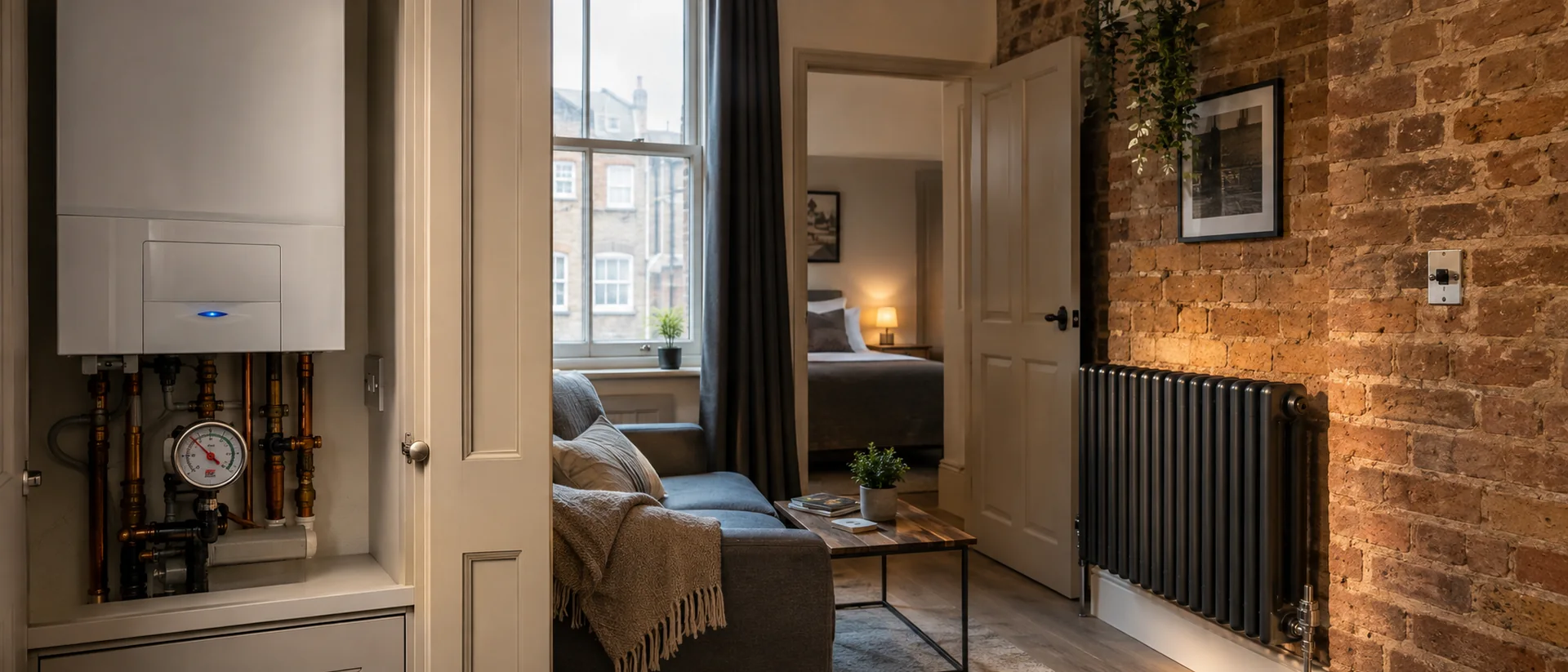
If pressure is low (below 1 bar on the gauge): the boiler has shut down as a safety measure. This is not a fault — it is the system working as intended. The guest can repressurise the boiler using the filling loop, a straightforward process that does not involve gas or any electrical component. Providing clear written instructions (which should be included in your host guide for every listing) resolves a significant proportion of London Airbnb boiler reports without any professional involvement at all.
If an error or fault code is showing: look up the manufacturer's error code guide online. Many codes — particularly F1, F22, or equivalent pressure-related codes — indicate low pressure. Others, such as ignition lockout codes, are often resolvable with a boiler reset. A reset is not appropriate for every fault code, but for a standard ignition lockout it is the correct first response.
If the guest reports the smell of gas, burning, or hears a CO alarm: instruct them to leave the property immediately without stopping to investigate, leave doors and windows open if they are able to do so safely, and call the National Gas Emergency Service on 0800 111 999. For a confirmed CO alarm, they should also call 999. Do not ask the guest to interact with the boiler, check pipework, or remain in the property under any circumstances. Seven does not provide out-of-hours emergency dispatch — for genuine emergencies of this kind, the gas emergency line and emergency services are the only appropriate first contacts.
For situations that are not immediate emergencies but that you cannot resolve through guest guidance, getting a professional assessment before dispatching anyone is both cost-effective and operationally sensible. Seven's free video consultation connects you with a vetted Gas Safe engineer who can assess the situation remotely before any callout is committed to — learn how the video consultation process works.
The Most Common Causes of Boiler and Heating Problems in London Airbnb Properties
London's housing stock creates specific vulnerabilities that hosts should understand. The following causes account for the large majority of boiler and heating reports across London short-let properties.
Low boiler pressure is the most common single cause of boiler shutdowns in London flats. Combi boilers — dominant in converted flats and purpose-built units across Tower Hamlets, Southwark, Lambeth, and inner west London — operate on a sealed pressurised system that gradually loses pressure through minor leaks, system micro-losses, and normal use. When pressure drops below approximately 0.5 bar, most boilers will shut down automatically. This is by design: it prevents the pump from running dry. The fix is repressurisation, not a repair.
Limescale build-up is a London-specific complication that hosts outside the capital rarely need to account for. Thames Water's supply — classified as "very hard" across central, east, and south London, and "hard" across much of the north and west — carries calcium carbonate concentrations that accelerate scale build-up in heat exchangers, diverter valves, and secondary circuits. London boiler engineers working on heating systems in period property conversions frequently note that heat exchanger descaling is often required significantly earlier than manufacturers' standard service schedules suggest. A boiler that performs well through 14 years in Leeds may develop heat exchanger restriction after 9 or 10 years in Bermondsey or Bow. Magnetic filters are not optional maintenance in London — they are near-essential for any boiler over five years old.
Faulty diverter valves are a common failure point in combi boilers older than eight years. The diverter valve controls the routing of heated water between the central heating circuit and the hot water tap demand. When it fails — partially at first — guests typically report that they can have heating or hot water, but not simultaneously. Full diverter valve failure results in loss of hot water, while the boiler attempts to fire without success. This is a component replacement job for a Gas Safe engineer and is not something that resolves with a reset or repressurisation.
Thermostat and timer settings account for a surprisingly high proportion of guest reports that turn out to be non-faults. A guest unfamiliar with a programmable room thermostat, a smart heating app, or a zone controller can inadvertently override or disable the heating schedule entirely. This presents identically to a boiler fault from the guest's perspective — no heat, system not responding — but is resolved by restoring the correct settings rather than by any trade intervention.
Frozen condensate pipes are a seasonal risk for London properties where the condensate drain exits externally. During London's cold snaps — which typically occur in January and February, and occasionally in March — external condensate lines can freeze and cause the boiler to lock out with a fault code. Victorian terraces in Hackney, Islington, and Haringey, where condensate pipes are often routed along external brick walls in poorly sheltered locations, are particularly susceptible to this failure mode.
Faulty zone valves or pump failure in properties with a separate hot water cylinder (system boilers rather than combis) can produce a complete loss of either heating or hot water while the other function continues normally. This is more common in larger period properties — particularly house conversions in Kensington & Chelsea, Richmond, or Wandsworth — where the original heating system has not been updated to a combi configuration.
Talk to a vetted Gas Safe engineer via free video call before committing to any callout fee. Understand exactly what the issue is and whether a site visit is necessary.
What Boiler Repairs Typically Cost in a London Airbnb
These are all-in London estimates covering the most common boiler and heating faults and preventive maintenance jobs hosts encounter. Ranges reflect variation across boroughs, boiler type, and access. They are illustrative — your actual cost depends on the specific fault and property.
Costs vary depending on boiler type, access, and the extent of the fault. A remote assessment before any site visit can clarify likely costs before an engineer travels to the property.
Get a free video consultation with a vetted Gas Safe engineer and 15% off your first request — the fastest way to understand your boiler fault and its likely cost before anyone visits your Airbnb.
Gas Safety Compliance: What London Airbnb Hosts Must Have in Place
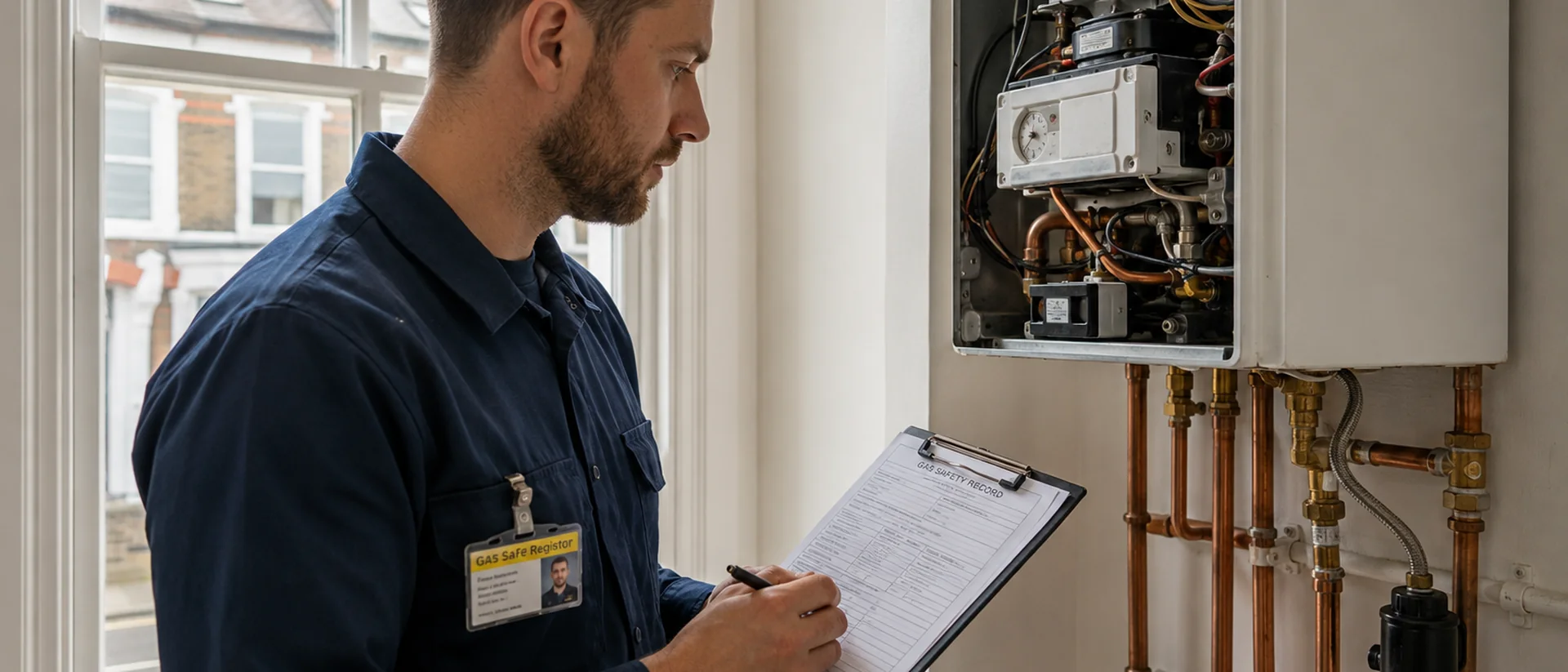
UK law makes no distinction between long-term tenants and short-let Airbnb guests when it comes to gas safety obligations. Under the Gas Safety (Installation and Use) Regulations 1998, any person who lets a property — including on a short-term basis — containing gas appliances is required to hold a current Landlord Gas Safety Record (CP12), renewed annually by a Gas Safe registered engineer. This applies whether the property is listed year-round on Airbnb, rented out for a single week, or anything in between.
The CP12 certificate confirms that all gas appliances, flues, and pipework in the property have been inspected and found to be in safe working condition. It must be renewed every 12 months, and records must be retained for at least two years. A copy should be available to guests on request — and in practice, having the most recent CP12 on file in the property or included in your digital welcome pack is good practice both for compliance and for guest confidence.
Gas Safe engineers are the only professionals legally authorised to work on gas appliances in the UK. Any engineer working on your boiler should provide their Gas Safe registration number before starting work. You can verify any engineer's registration and the appliance categories they are qualified to work on at gassaferegister.co.uk. Unregistered gas work constitutes a criminal offence under the same Regulations.
Beyond the CP12 requirement, the Building Safety Act 2022 requires that all occupied residential premises with fixed combustion appliances — which includes gas boilers — have a working carbon monoxide detector installed on the same floor as the appliance. For a London Airbnb property, this means a CO alarm in the utility cupboard, kitchen, or boiler room where the boiler is located. CO alarms have a finite lifespan (typically seven to ten years) and must be tested at each changeover.
An annual service appointment — which generates the CP12 certificate — also serves as a practical maintenance function. A competent engineer will identify developing faults, descale or inspect the heat exchanger, check the pressure relief valve, verify flue gas performance, and confirm that the condensate drain is clear and correctly routed. Skipping the annual service does not just create a legal exposure — it removes the only structured opportunity to catch problems before a guest stay.
How to Triage Heating Issues Remotely Before Dispatching a Tradesperson
For London Airbnb hosts who live at a distance from their property — or who are managing London listings from abroad — the pressure of a guest reporting no heating creates an immediate urge to send someone to the property. This instinct is understandable but frequently leads to unnecessary callout fees, particularly when the underlying issue turns out to be a pressure fault, a thermostat setting, or another non-fault condition.
A structured remote assessment changes the economics of the response. By speaking directly with a qualified professional before any site visit, a host can establish whether the issue is likely a non-fault condition the guest can safely resolve, understand what an engineer will need to do if a visit is required, assess whether the fault is serious enough to warrant emergency attendance or whether it can be booked as a standard appointment, and make an informed decision about whether the guest needs to be relocated or whether the situation is manageable in place.
Seven's free video consultation connects London Airbnb hosts directly with vetted Gas Safe registered professionals who can assess a heating situation remotely. The engineer can look at error codes visible on the boiler display, discuss the heating system configuration, and walk through the diagnostic steps with the host and guest together — before anyone commits to a physical visit. This is particularly valuable for hosts managing properties in Tower Hamlets or Lewisham from a north London address, or overseas hosts managing Zone 2 listings who cannot reach the property within a reasonable time.

It bears repeating clearly: Seven is not an emergency dispatch service and does not provide out-of-hours callout coverage. For genuine gas emergencies — gas smell, CO alarm, suspected leak — 0800 111 999 and 999 are the correct contacts. Once the immediate situation is contained and safe, Seven's video consultation is the right next step for determining what maintenance work is needed and booking the appropriate engineer. Find out more about Seven's boiler and heating service.
Free video consultation with a vetted Gas Safe engineer before any callout. Understand the problem and whether a site visit is genuinely needed — protecting your guest's stay and your listing's rating.
Heating Issue Decision Reference Table
The following table provides a quick-reference guide to the most common guest-reported heating situations in London Airbnb properties, their likely causes, and the appropriate first response.
| Guest Reports | Likely Cause | First Action |
|---|---|---|
| No heat, no hot water, boiler display off or showing pressure fault | Low boiler pressure | Check pressure gauge; repressurise if below 1 bar |
| No heating only; hot water fine | Thermostat setting, room stat, or zone valve | Check thermostat settings before requesting any engineer |
| Fault/error code showing on display | Varies by manufacturer code | Look up code — many are reset-resolvable; others need Gas Safe engineer |
| Gas smell or CO alarm | Gas leak or CO risk | Evacuate immediately. Call 0800 111 999. Do not investigate. |
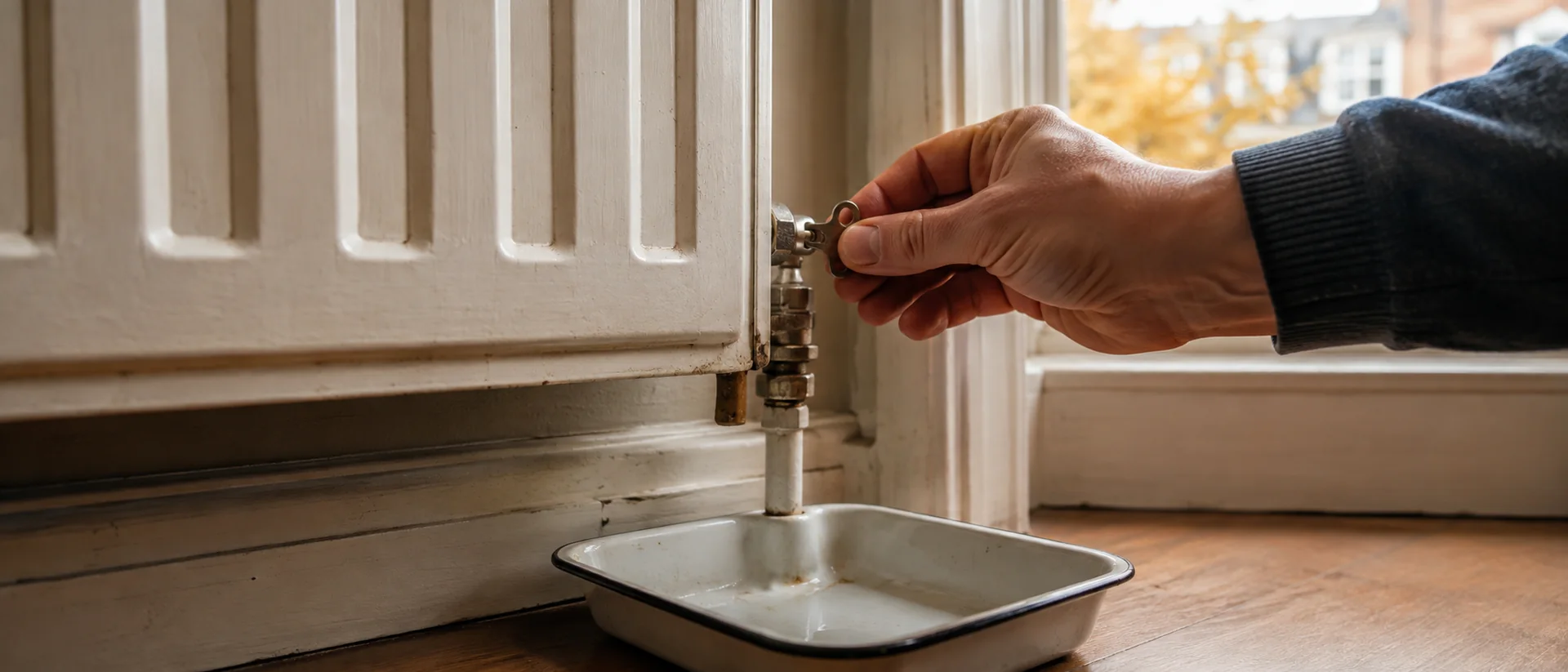
| Radiators cold at top, warm at bottom | Trapped air in system | Not a boiler fault — radiators need bleeding |
| Heating works, but no hot water | Diverter valve (combi) or hot water cylinder (system boiler) | Gas Safe engineer required — not a self-resolve fault |
| Boiler fires repeatedly and switches off | Low pressure, scale, or sensor fault | Check pressure first; if normal, Gas Safe engineer required |
Preventing Heating Failures Between Bookings
Reactive management of heating faults is inevitable — but prevention is substantially cheaper for any London Airbnb host operating across multiple bookings per year. The following steps provide the highest return on maintenance investment.
Annual boiler service is the single most important preventive action, and it is legally required in any case for properties with gas appliances. A service by a Gas Safe registered engineer (which generates the CP12 certificate) will identify developing faults, inspect and clean the heat exchanger, check the pressure relief valve, assess the condensate drain, and calibrate the controls. The cost across London typically sits between £80 and £140 depending on engineer, location, and boiler type — considerably less than even a single unnecessary emergency callout, and a fraction of the cost of a component replacement that could have been identified at service stage.
Install a magnetic system filter if one is not already fitted. These in-line devices (Magna Clean, Adey, and similar brands) capture iron oxide sludge that circulates in older central heating systems. In London's period property stock — particularly Victorian conversions in Hackney, Islington, and Wandsworth, where radiator pipework is sometimes original to the 1970s or 1980s — sludge build-up is a recurring cause of pump failure, boiler inefficiency, and heat exchanger restriction. A magnetic filter typically costs £80–£150 to supply and fit, and it significantly extends the effective service life of the boiler.
Insulate external condensate pipes before the winter season. For properties where the condensate outlet runs along an exposed external wall — common in Victorian terraces across the inner boroughs — closed-cell foam pipe lagging prevents the seasonal freezing that causes annual lockouts during cold weather. This is a low-cost preventive measure that eliminates one of the most predictable and avoidable winter fault causes.
Install a smart thermostat or remote heating controller. Smart heating systems (Hive, Nest, and comparable products) allow a host to monitor the actual temperature in the property, verify that the heating schedule is active, and adjust settings remotely without guest involvement. They also allow the host to quickly assess whether a guest-reported "no heating" situation is a control settings issue or a genuine boiler fault — a distinction that determines whether a professional needs to attend at all.
Test the full heating system at least 48 hours before each check-in, particularly at the start of the winter season. A 20-minute full-system run on a dry September afternoon will surface pressure issues, cold radiator spots, and any fault codes that have accumulated since the last stay. Catching a fault before a guest arrives is the only version of this problem that does not cost you a review.
Provide a clear heating guide in your welcome information. A brief written note explaining where the boiler is, what a normal pressure reading looks like, how the thermostat works, and what to do if the heating stops prevents a significant proportion of false fault reports. Guests who understand the controls are far less likely to report a problem that is actually a thermostat scheduling issue.
Frequently Asked Questions
What should I do if my Airbnb guest reports the boiler has stopped working?
First, establish exactly what the guest is experiencing — no heating, no hot water, or both — and whether the boiler displays any error code or warning light. Check the pressure gauge reading: most combi boilers require 1–1.5 bar to operate. If the pressure is low, the guest may be able to repressurise using the filling loop if they are comfortable doing so. If a fault code is showing, look up the manufacturer's guide before requesting an engineer. For any smell of gas or CO alarm, guests must leave the property immediately and call the National Gas Emergency Service on 0800 111 999 — this takes priority over everything else.
Do I need a gas safety certificate for my London Airbnb property?
Yes. Under the Gas Safety (Installation and Use) Regulations 1998, any property let to paying guests — including short-let Airbnb listings — containing gas appliances must hold a current Landlord Gas Safety Record (CP12), renewed annually by a Gas Safe registered engineer. Operating without a valid CP12 is a criminal offence and will invalidate most property insurance policies. The requirement applies regardless of how frequently the property is let.
How much does it cost to fix a boiler in a London Airbnb property?
Costs vary significantly depending on the nature of the fault. A callout to diagnose and resolve a lockout or pressure issue typically costs £80–£150 in London. A diverter valve replacement commonly runs £200–£350 including parts and labour. A full boiler replacement in a London flat typically costs £2,000–£3,500 including installation, depending on the unit and the complexity of the access. Getting a remote assessment of the fault before committing to any site visit can clarify likely costs before the engineer travels to the property.
Does London's hard water damage boilers faster?
Yes, meaningfully so. Thames Water's supply to central, east, and south London is classified as very hard, with calcium carbonate concentrations that accelerate limescale build-up in heat exchangers, flow sensors, and secondary circuits. This is why annual servicing is especially important in London — and why magnetic filters and periodic descaling are widely recommended for London boilers over six years old. Whether this applies to your specific property and boiler depends on the installation age and water hardness for your postcode — a Gas Safe engineer can assess this on site.
Does Airbnb cover boiler breakdowns or heating failures?
Airbnb's AirCover for Hosts provides some cover for property damage caused by guests, but it does not cover the cost of boiler repair or mechanical breakdown. Heating system failures that are unrelated to guest damage fall entirely to the host. Specialist short-let property insurance products exist that typically include mechanical and electrical breakdown cover, and these are worth reviewing before your next renewal if you are not already covered.
What: A step-by-step guide for London Airbnb hosts on handling boiler and heating failures — legal gas safety obligations, the most common causes of breakdowns in London's housing stock, remote triage steps, and prevention between bookings.
Legal requirement: Under the Gas Safety (Installation and Use) Regulations 1998, every London Airbnb with gas appliances must hold a current Landlord Gas Safety Record (CP12), renewed annually by a Gas Safe registered engineer — no exceptions for short-let use.
Most common cause: Low boiler pressure is responsible for the majority of guest-reported heating faults in London flats, and is often resolvable by the guest using the filling loop without any engineer visiting.
Typical London repair costs: £80–£150 for a callout to diagnose a lockout or pressure fault, £200–£350 for a diverter valve replacement, £80–£140 for an annual service, and £2,000–£3,500 for a full boiler replacement.
Emergency protocol: For any smell of gas, burning, or a CO alarm, guests must leave the property immediately and call the National Gas Emergency Service on 0800 111 999 — and 999 for a confirmed CO alarm. This overrides every other step in this guide.
Seven Services: A London home-services marketplace offering a free video consultation with a vetted, insured Gas Safe engineer before any callout is confirmed, with 15% off a host's first request.
From pressure faults to full boiler replacements. Free video consultation and a fixed-price quote before anyone visits your Airbnb — available across all 32 London boroughs.