This article provides general guidance about gas safety certificate costs and legal obligations for London landlords. It does not constitute professional advice. For any concerns about your specific gas installation, a Gas Safe registered engineer should assess it in person.
What Is a Gas Safety Certificate and Why London Landlords Must Have One
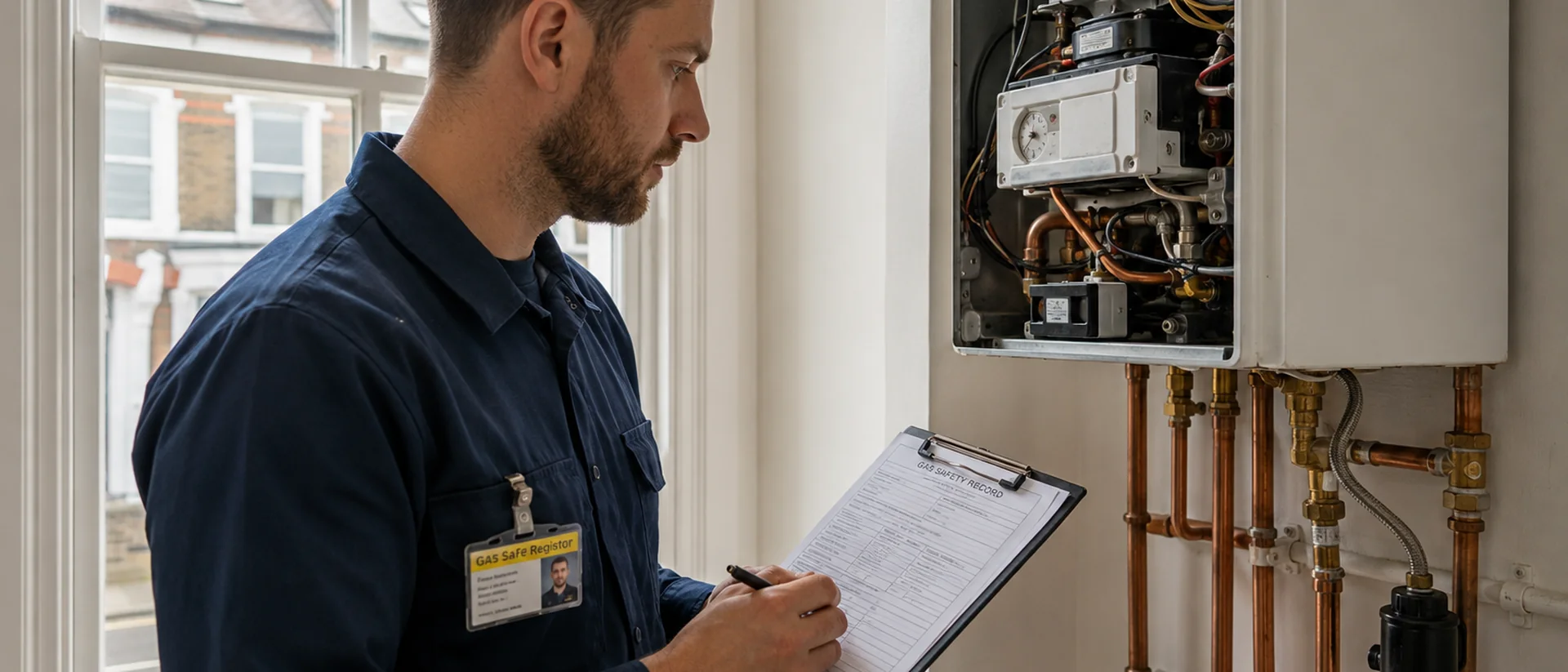
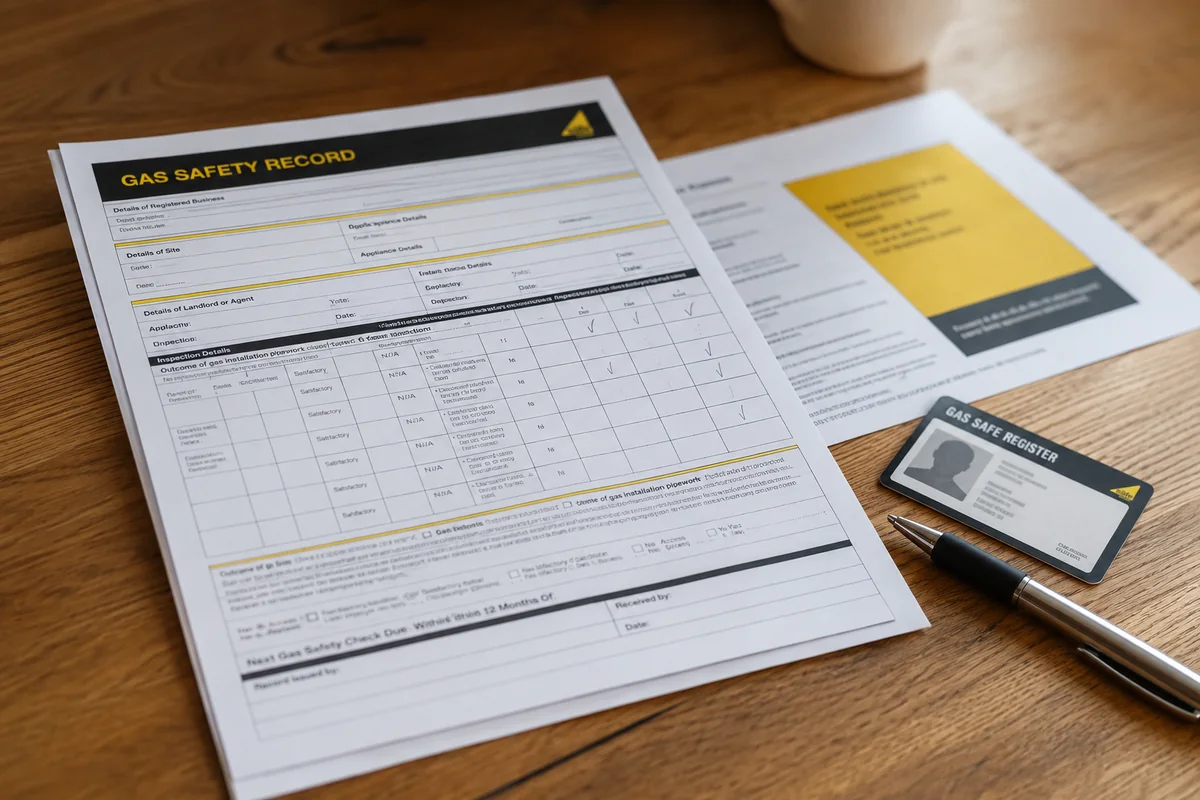
The Gas Safety Record — still widely called the "CP12" by landlords and engineers, though that designation was retired when the Gas Safe Register replaced CORGI in April 2009 — is the official document confirming that every gas appliance, fitting, flue, and supply pipe in a rental property has been inspected and found safe by a Gas Safe registered engineer.
Under the Gas Safety (Installation and Use) Regulations 1998, every private landlord letting residential property in England, Scotland, and Wales must arrange an annual inspection. There is no exemption for newer properties, well-maintained systems, or properties where the boiler was replaced recently. If the property has a live gas supply, the obligation applies — even if the last check came back entirely clear and the boiler is only two years old.
The Gas Safe Register is the statutory body overseeing gas safety work in the UK, established to replace the CORGI scheme. Only engineers who hold current Gas Safe registration — covering the specific category of appliance they are inspecting — are legally authorised to carry out this work and issue certificates. Registration for domestic gas boilers does not automatically extend to gas fires, LPG appliances, or communal heating plant; the category of registration matters and is worth verifying before you book.
For London landlords managing properties across the capital, keeping a structured record of each property's certificate expiry date is a routine but essential compliance task. A structured overview of London landlord safety certificate obligations covers the full picture — including EICR requirements, smoke alarm compliance, and EPC obligations — for landlords who want to review all their legal duties in one place.
How Much Does a Gas Safety Certificate Cost in London in 2026?
A gas safety check for a London rental property with a single gas boiler typically costs between £65 and £130 in 2026. Properties with multiple gas appliances, or those with the access constraints common across inner London, will sit at the higher end or above that range. The list below provides a realistic breakdown by property type and location.
These are honest 2026 estimates; each additional gas appliance (hob, gas fire) typically adds £15–£30 to the total. Getting at least two written quotes — from engineers whose Gas Safe registration you have verified — is always sensible practice.
Get a free video consultation with a vetted, Gas Safe registered London engineer and 15% off your first request — booking through the app is the fastest way to get a fixed price.
What a Gas Safety Inspector Actually Checks
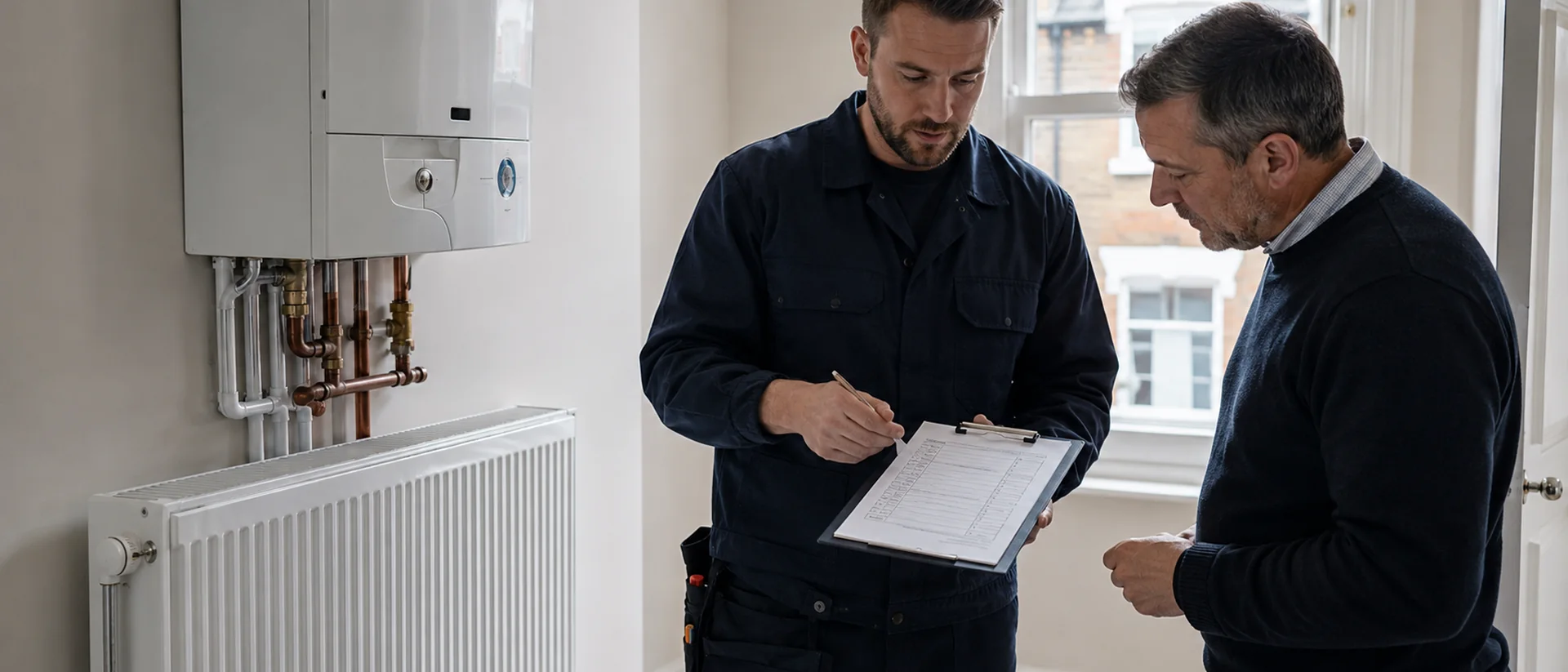
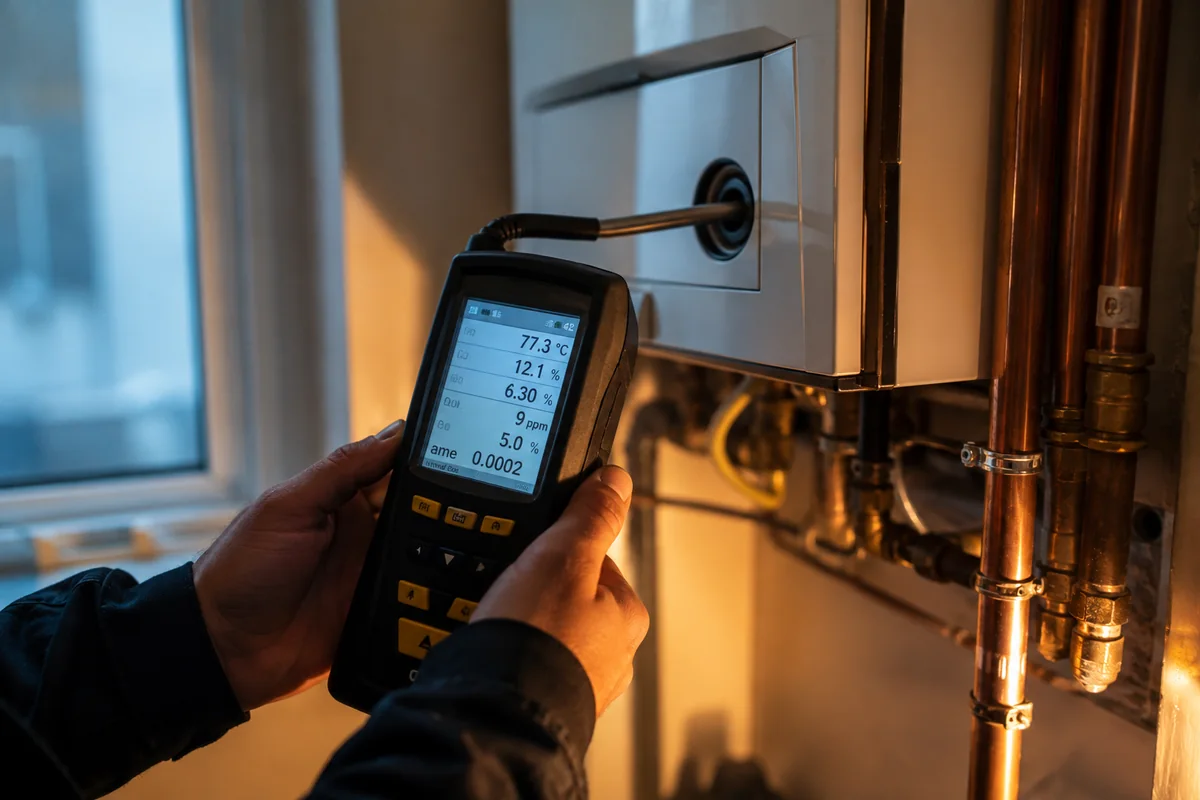
The inspection covers every gas installation in the property. For a standard London flat with a combi boiler and no additional appliances, the engineer will inspect the boiler itself — heat exchanger integrity, burner operation, combustion performance, safety controls, and flue connections — as well as the gas supply pipework from the meter to the appliance. They will test gas pressure and flow rate, check for evidence of gas leaks using electronic detection equipment, and assess whether the installation has adequate ventilation for safe combustion.
Where additional appliances are present, each one is inspected separately. A gas hob requires a check of the burners, ignition system, and the flexible connection to the supply pipe. A gas fire requires inspection of the burner, controls, glass panel where applicable, and the flue or flueless installation type. Every appliance present must be found safe before a certificate covering the property can be issued.
One aspect of the inspection that frequently creates complications in London's older housing stock is the flue system assessment. The flue must terminate in a safe location relative to windows, air bricks, and neighbouring openings — requirements set out under BS 5440. In Victorian and Edwardian properties that have been subdivided into flats, the routing and termination of flue systems is sometimes non-compliant with current standards — not because anything has changed with the boiler itself, but because a subsequent conversion altered the building around it. Whether your specific installation qualifies for a clean certificate, or whether remedial work is needed first, depends on the actual condition of the system. Only a Gas Safe registered engineer can assess this on site.
For landlords managing Victorian stock or older gas installations, Seven's free video consultation with a vetted Gas Safe engineer lets you discuss your specific property before committing to a booked visit. See how it works →
Who Can Issue a Gas Safety Certificate in London?
Only a Gas Safe registered engineer — and only one whose registration covers the specific category of appliance being inspected. This is not a discretionary rule. Any certificate issued by an engineer who is not on the Gas Safe Register, or who is not registered for the relevant appliance category, has no legal standing, regardless of how competent the inspection was.
Always verify an engineer's Gas Safe registration at gassaferegister.co.uk before confirming any booking. The register allows you to search by name or by the registration number on their Gas Safe ID card. The card must be current — registration is renewed annually — and must list the correct category. The most common relevant category for London rental properties is "domestic" (which covers central heating boilers and gas supply pipes), but if your property has a gas fire or LPG appliance, confirm that the engineer is registered for those categories too.
A pattern frequently seen among London landlords managing portfolios across multiple boroughs is booking gas safety checks through their letting agent's recommended contractor list without independently verifying the engineer's Gas Safe registration. This is a compliance risk: the obligation to hold a valid certificate belongs to the landlord, not the letting agent, and an unverifiable certificate leaves the landlord exposed even if the agent arranged the booking in good faith.
London-Specific Cost Factors That National Price Guides Ignore
National gas safety certificate cost guides quote a range of £60–£120 and leave it at that. For London landlords, this misses several factors that are distinctly London-specific and that experienced engineers consistently price into their quotes.
Controlled Parking Zones (CPZs). The majority of inner London is covered by CPZs, and an engineer arriving to carry out a 45-minute inspection typically needs to pay for a pay-and-display bay or short-term suspended bay permit. In boroughs like Islington, Hackney, Southwark, and Lambeth — where daytime parking enforcement is active throughout working hours — these costs, typically £3–£8 per visit, are routinely factored into the engineer's overall fee. Engineers quoting flat rates for "London" without addressing parking should be asked whether access charges are included.
Congestion Charge. Properties within the Congestion Charge zone — broadly covering the area from Hyde Park Corner to Aldgate and from Elephant and Castle to Euston — generate a £15 daily charge for the engineer's vehicle. Some engineers absorb this into a flat London rate; others add it as a line item. It is worth clarifying before booking, particularly for properties in Westminster, the City of London, or southern parts of Islington and Hackney that sit near the zone boundary.
Mansion blocks and high-rise access. A recurring issue for landlords managing Victorian and Edwardian mansion block stock — particularly in Kensington, Chelsea, Marylebone, and St John's Wood — is that the combination of no dedicated parking, lifts that require resident assistance, and narrow service corridors makes each inspection visit more logistically complex than a standard house call. Engineers who regularly work in these buildings factor in additional time, which is reflected in their pricing.
Victorian terrace pipework. Original gas pipework installed during the postwar conversion of terraced houses to flats — often threaded steel fittings and compression joints rather than modern push-fit connections — takes longer to inspect thoroughly and is more likely to require attention before a certificate can be signed off. In Lewisham, Haringey, and Walthamstow — where the Victorian terrace-to-flat conversion rate is particularly high — gas safety checks on older properties routinely take 20–30 minutes longer than on a modern flat with a standard combi boiler and contemporary pipework.
To put numbers on the geography: in Kensington & Chelsea and Westminster, where period property density is highest and parking enforcement most rigorous, gas safety checks typically sit at £110–£130 for a single-boiler property. In outer boroughs like Havering, Sutton, and Kingston upon Thames, the same inspection with an equivalent calibre of engineer typically costs £65–£85.
What Happens If You Don't Have a Valid Gas Safety Certificate
The consequences of failing to comply with the Gas Safety (Installation and Use) Regulations 1998 are considerably more serious than many landlords appreciate. Non-compliance is a criminal offence — not a civil penalty, not an administrative fine that arrives by post. The Health and Safety Executive is the enforcement authority and can prosecute landlords directly, even in the absence of a gas-related incident.
Penalties include an unlimited fine and up to six months' imprisonment on conviction. In practice, most HSE prosecutions result in substantial fines — particularly where an incident has occurred in a property without a valid certificate — but the HSE has also prosecuted landlords who simply failed to arrange inspections over multiple years, with no incident, on the basis that the ongoing risk was unacceptable.
Beyond the criminal law exposure, the practical consequences in 2026 include the following:
- Section 21 invalidity: The Deregulation Act 2015 requires landlords in England to have provided tenants with a valid gas safety certificate before serving a Section 21 no-fault eviction notice. A missing or expired certificate at the time the notice is served can render it legally invalid, requiring the landlord to obtain a valid certificate and serve an entirely new notice — adding months to any possession process.
- Insurance voidance: Most landlord building and liability insurance policies contain clauses requiring the property to comply with all statutory requirements. A gas-related incident in a property without a current certificate gives the insurer grounds to deny a claim entirely, leaving the landlord personally liable for third-party injuries or property damage.
- Local authority enforcement: London borough housing enforcement teams investigate tenant complaints about missing certificates. In Tower Hamlets, Newham, and Lambeth — where proactive housing enforcement has been strengthened in recent years — landlords found without valid gas safety records during a council inspection can receive Improvement Notices under the Housing Act 2004, with mandatory compliance timescales and further penalties for non-compliance with the Notice itself.
- Gas network disconnection: Cadent Gas (north and east London) and Southern Gas Networks (south London) have powers to disconnect a supply where they attend a property and identify an unsafe or uncertified installation. Reconnection typically requires a Gas Safe engineer to inspect and certify the installation — at the landlord's cost — before the network will restore supply.
Video triage with a vetted London Gas Safe engineer before any callout. Understand which properties need attention and confirm appliance configurations before booking inspection visits. See how it works →
HMO Properties and Leasehold Flats — Who Is Responsible?
For Houses in Multiple Occupation, the obligation to arrange and pay for the annual gas safety check rests entirely with the landlord — regardless of whether the property is managed by a letting agent or property manager. This is not affected by the HMO category. Whether the property is a mandatory HMO (five or more occupants from two or more households) or subject to additional licensing at borough level, the landlord's responsibility is the same.
In London, where additional HMO licensing schemes operate across a growing number of boroughs — including Islington, Hackney, Southwark, Tower Hamlets, Brent, Waltham Forest, and Ealing — gas safety compliance is a licensing condition. An expired or absent certificate identified during a licensing inspection can trigger a review and potentially the suspension or revocation of the HMO licence, which prevents the property from being legally let in that configuration.
In leasehold properties — which account for a very large share of London's rental stock, particularly in purpose-built mansion blocks and converted buildings — the position depends on the specific lease. Where a communal boiler or central heating plant serves multiple flats, the freeholder or management company is responsible for inspecting and certifying the communal system. Leaseholders with their own self-contained gas supply and boiler within their demised premises are responsible for that installation, entirely separately from whatever the managing agent does with any communal system. If you are unclear which applies to your property, the lease will set this out — or a Gas Safe engineer can advise on what falls within your demised premises and what is communal.
Timing Your Annual Check and Getting the Best Value in London
Gas safety certificates are valid for 12 months from the date of inspection — not from the calendar year end, and not from the tenancy start date. If your last check was carried out on 12 September 2025, the certificate expires on 12 September 2026. Keeping a property-by-property record of actual expiry dates is essential for landlords with more than one property, particularly where inspections are on different annual cycles.
Gas Safe engineers across London are most in demand between October and February, when boiler breakdowns, pre-winter servicing, and certificate renewals all peak at the same time. Booking in the summer — July and August — offers more availability, more flexible appointment slots, and less risk of being unable to find an engineer before your certificate lapses. For landlords whose certificates expire in autumn, this window provides enough lead time to schedule the inspection, complete any remedial work that emerges, and have the certificate issued before the deadline.
Combining the annual gas safety check with a boiler service is one of the most cost-effective strategies available to London landlords. A boiler service in London typically costs £85–£130. If the same Gas Safe engineer carries out both on a single visit, the combined fee is usually £130–£180 — saving the cost of a second call-out and, more importantly, ensuring the boiler is in good working order before the inspection begins. A well-serviced boiler is less likely to have a safety issue that prevents the certificate being issued on the first visit.
For landlords managing several London properties with different inspection dates, Seven's free video consultation with a vetted Gas Safe engineer lets you discuss the requirements for each property — confirming appliance configurations, addressing concerns about older installations, and clarifying scope — before committing to booked site visits. This removes the risk of an engineer arriving at a property and encountering unexpected complications that require a return visit. See how Seven connects you with Gas Safe engineers in London.
Frequently Asked Questions
What: A cost guide to gas safety certificates (CP12 / Gas Safety Records) for London landlords in 2026 — legal requirements, real prices by borough and property type, what's checked, and the consequences of not having a valid certificate.
Typical London cost: £65–£130 for a single-boiler property in 2026. Outer London sits at £65–£85; inner London CPZ areas £80–£105; Congestion Charge zone properties £95–£130. Each extra gas appliance adds £15–£30, and HMOs with 3+ appliances can reach £150 or more.
Legal requirement: The Gas Safety (Installation and Use) Regulations 1998 require an annual inspection by a Gas Safe registered engineer for every tenanted property with a live gas supply, with no exemption for newer boilers. Certificates go to existing tenants within 28 days and to new tenants before move-in.
Consequences of non-compliance: A criminal offence carrying an unlimited fine and up to six months' imprisonment, plus invalid Section 21 notices, voided landlord insurance, local authority Improvement Notices, and potential gas network disconnection.
London-specific cost drivers: Controlled Parking Zone charges, the Congestion Charge, mansion block access complexity, and Victorian steel pipework that takes longer to inspect all push inner and central London costs above the national average.
Seven Services: A London home-services marketplace offering a free video consultation with a vetted, Gas Safe registered engineer before any callout is confirmed, with 15% off a customer's first request.
Vetted, Gas Safe registered engineers for annual certificates and boiler services. Fixed-price quotes in writing, free video consultation before any visit — available across all 32 London boroughs.