Watersafe registered plumbers across all 32 London boroughs. Leaks, blocked drains, replumbing, bathroom installation and more — with a free video consultation before any callout.
Watersafe registeredFully insured4.9 · 267 reviewsAll 32 London boroughs
What is a plumbing service in London?
A qualified plumber installs, repairs, and maintains the water supply, drainage, and heating pipework in residential and commercial properties across London. All plumbing connected to the public water supply must comply with the Water Supply (Water Fittings) Regulations 1999, which govern the design, installation, and maintenance of water fittings to prevent contamination, waste, and misuse of water.
Seven Services connects you with vetted, Watersafe registered, fully insured plumbers across all 32 London boroughs. Every booking includes a free video consultation — so a qualified professional assesses your issue remotely before committing to a visit. A pattern frequently seen in London Victorian and Edwardian properties is that what appears to be a minor leak at the visible fixture is often a symptom of a wider issue — ageing compression fittings, corroded iron waste pipes, or failing supply joints hidden inside floor voids. Diagnosing this before the visit means the plumber arrives with the right parts rather than making a second trip.
At a glance
Plumbing Services — Key Facts
Coverage
All 32 London Boroughs
Certification
Watersafe / WIAPS
Key regulation
Water Fittings Regs 1999
Hourly rate from
£80 per hour
Leak repair from
£100 fixed price
Drain clearance from
£85 fixed price
Booking
App or Web
Video consultation
Free, before any callout
Why Seven Services
What makes our plumbers different
Plumbing problems in London rarely look exactly like they are. A free video call before any visit changes that entirely.
Free video consultation first
A qualified plumber assesses your issue on a live video call before anyone travels to the property. You show them the leak, the blocked drain, or the failed fitting — they diagnose the most likely cause, confirm what's needed, and quote a fixed price. No callout fee for an assessment that leads nowhere.
Watersafe registered — verified not claimed
Every plumber on the platform is verified against the Watersafe or WIAPS register before joining. These schemes confirm that the professional is trained to comply with the Water Supply (Water Fittings) Regulations 1999 — the legal standard for all plumbing in England and Wales connected to the public water supply.
Fully insured on every job
All professionals carry public liability insurance. For water damage — which can spread quickly through a London period conversion — knowing the professional is insured before work begins is not optional. We verify coverage before confirming bookings for higher-risk jobs such as pipe replacement and bathroom installation.
Fixed price agreed before the visit
Scope and price are agreed during the video consultation — before anyone travels. This removes the most common source of plumbing disputes: arriving to find the job is bigger or more complex than the initial description suggested.
All 32 London boroughs covered
From Barnet to Bromley, Hillingdon to Havering — our network covers every borough. This matters particularly for landlords managing properties across multiple London postcodes who need a single reliable source for plumbing work.
London property expertise
Victorian and Edwardian properties make up the majority of London's housing stock. The professionals on the platform understand lead pipes, iron waste stacks, solid floors, and party wall constraints — the recurring complications that make London plumbing different from equivalent work elsewhere in the UK.
What we cover
Plumbing services available in London
From a dripping tap to a full replumb — here is what vetted plumbers on the platform cover.
Not sure exactly what type of plumber you need? A free video call with a qualified plumber can diagnose the issue and confirm the right approach before anyone visits your property.
Leak Detection & Repair
Visible leaks at taps, joints, and connections are straightforward to assess and quote. Hidden leaks — inside walls, beneath floors, or within the soil stack — are more complex and often require specialist acoustic or thermal detection equipment. A pattern frequently seen in London Victorian terraced houses is that the first sign of a leak is a damp patch on a ground-floor ceiling, which is often originating from a compression joint under the bathroom floor above rather than from the visible pipework.
During the video consultation, a plumber can assess whether the visible symptoms suggest a localised leak or a more systemic issue — helping avoid an unnecessarily large investigation before the source is confirmed.
1–4 hours £100–£450 No certification required
Blocked Drains & Toilets
Blockages range from simple toilet clogs cleared with a plunger to complete soil stack obstructions requiring drain rods, high-pressure jetting, or CCTV survey. A common situation in London period conversions — particularly flats in Islington, Hackney, and Southwark that share a single soil stack between multiple flats — is that a recurring blockage in one flat originates from a build-up lower in the shared stack, not from the individual flat's own drainage. Identifying this during a video consultation before dispatching a plumber prevents a wasted visit.
30 min – 3 hours £85–£350 No certification required
Tap & Fitting Repair
Dripping taps, stiff mixer taps, seized isolation valves, and failing shower cartridges are among the most frequent plumbing jobs in London rental properties. While individually low-cost, a dripping tap left unaddressed wastes a significant volume of water and will eventually fail more expensively. For landlords managing multiple properties, a single video consultation can cover the condition of several fittings — reducing the number of individual callouts required.
30 min – 2 hours £80–£220 No certification required
Full & Partial Replumb
A full replumb replaces all water supply pipework in a property — from the incoming stopcock to every outlet. A partial replumb replaces a specific section of pipework, such as the lead service pipe, the bathroom supply, or a corroded section beneath the kitchen floor. London Victorian and Edwardian properties with lead supply pipes or iron supply pipework are the most common candidates. A partial replumb targeting only the most problematic sections is often the most cost-effective approach for a property that is otherwise in reasonable condition.
The Water Supply (Water Fittings) Regulations 1999 require notification to Thames Water for certain larger works — your plumber handles this as part of the job.
2–10 days £1,500–£9,000 Notifiable work — Thames Water
Bathroom Installation
Full bathroom installation and refurbishment — from removing the existing suite to installing new sanitaryware, tiling, and finishing. A bathroom installation involves plumbing, waterproofing, tiling, and sometimes electrical work (extraction fans, heated towel rails, shaver sockets) — all of which require separate qualifications. Through Seven Services, a bathroom project can be coordinated across trades, with the plumber, electrician, and tiler matched and managed through the same platform.
5–12 days £3,000–£12,000 Part P if electrical work involved
Unvented Hot Water Systems
Unvented hot water cylinders (pressurised systems such as Megaflo and Vaillant uniSTOR) must be installed, commissioned, and serviced by a G3-qualified engineer. This is a legal requirement under Part G of the Building Regulations — unvented cylinders store large volumes of water at high temperature and pressure, and incorrect installation or maintenance creates a serious risk of vessel failure. The G3 qualification is separate from the general plumbing Watersafe registration — always confirm this specifically when booking unvented hot water work.
Half day – 2 days £800–£2,500 G3 Building Regs compliance
Stopcock & Isolation Valve Work
Locating and testing the property stopcock is one of the most overlooked aspects of property maintenance in London. In Victorian terraces, the internal stopcock is often behind boxing under the kitchen sink or in a cupboard beneath the stairs — and has frequently not been operated for decades. A seized stopcock that cannot be closed in an emergency converts a manageable leak into a significant water damage event. During a video consultation, a plumber can guide the customer through locating and testing the stopcock before any visit is needed.
30 min – 2 hours £80–£200 No certification required
Outside Taps & Garden Water
Installation of an external tap requires a double-check valve to comply with the Water Supply (Water Fittings) Regulations 1999 — this prevents backflow contamination of the public water supply. This is notifiable work under the regulations and must be reported to Thames Water prior to installation. It is also a job frequently done incorrectly by unregistered tradespeople — creating a legal liability for the homeowner. A Watersafe registered plumber handles the notification and uses approved fittings as a matter of course.
1–3 hours £150–£350 Notifiable work — Thames Water
Common issues
Plumbing problems London homeowners face
These are the most frequently reported plumbing issues in London properties — and what they typically indicate.
Not sure if your issue is urgent?
A free video call with a qualified plumber assesses the risk before anyone visits — no callout fee.
Damp patches on walls or ceilings that are not near visible plumbing are often caused by a leak inside the structure — from a supply pipe, a waste connection, or a failed shower tray seal. In London period conversions, the most common culprit is a failed compression joint or an ageing flexible hose connection that has corroded inside a cupboard or floor void. Left unaddressed, these become structural damage issues, not just plumbing issues.
Low water pressure throughout
Consistently low pressure throughout a property — not just at one outlet — usually indicates a problem at the supply point: a partially closed or corroded stopcock, a failing pressure regulator, or a supply pipe that has partially scaled or corroded. In London Victorian properties with original lead supply pipes, the pipe diameter itself is sometimes insufficient for modern demand. Thames Water's Lead Pipe Replacement Scheme may be relevant if the lead supply pipe is on the public section.
Recurring blocked drains
A drain that blocks repeatedly after clearing is usually a structural problem, not a usage problem. Common causes in London properties include root intrusion from street trees into older clay drain runs, collapsed sections in Victorian-era drainage, or a belly (low spot) in the drain run that allows solids to accumulate. A CCTV drain survey identifies the precise cause — clearing a drain repeatedly without surveying it is treating the symptom indefinitely.
Water hammer — banging pipes
A banging or knocking sound in pipes when a tap is turned off or a washing machine valve closes is called water hammer — a pressure surge caused by a sudden stop in water flow. In London properties with high mains pressure, this can be significant enough to loosen joints over time. The solution is typically a pressure reducing valve, a water hammer arrestor, or securing loose pipework — depending on the cause identified during assessment.
Slow-emptying bath or shower
A bath or shower that drains slowly but does not block completely usually has a partial blockage in the trap or the first section of waste pipe — typically hair and soap residue. In period conversions with older cast iron waste systems, the same symptom can indicate partial scaling of the waste pipe itself, particularly where hard London water has deposited scale over decades. Clearing the trap first is the correct first step — escalating to chemical or mechanical descaling if the problem persists.
Boiler pressure keeps dropping
A boiler that repeatedly needs repressurising suggests either a leak somewhere in the sealed heating circuit (a radiator, valve, underfloor heating pipe, or connection at the boiler itself) or a failing pressure relief valve that is releasing pressure as designed but indicating a fault. This is a boiler and plumbing overlap — the plumber investigates the circuit; the gas engineer investigates the boiler components. A video consultation helps identify the starting point before booking the right trade.
Pricing guide
How much does a plumber cost in London?
London plumbing rates reflect the complexity of the city's housing stock, not just the trade. These are realistic 2026 market ranges — not minimum advertised rates designed to attract enquiries.
Unsure what your job should cost?
A free video consultation produces a realistic scope and cost estimate before any visit.
Why London plumbing costs more than national averages
Three factors consistently increase plumbing costs in London compared to the rest of England:
Property construction. Solid masonry walls in Victorian and Edwardian stock mean pipes cannot be threaded through cavities — they must be chased or surface-run. Solid floors (common in ground-floor conversions in Lewisham, Lambeth, and Southwark) require more disruptive access than suspended timber floors.
Lead pipework. Replacing lead supply pipes is more complex than replacing copper — the connection to the communication pipe at the boundary requires a Thames Water-approved connector and coordination with the network operator. In some cases, Thames Water must replace their section of the pipe simultaneously, adding coordination time.
Access and parking. London's dense terrace streets often have permit-only parking, no side access to properties, and shared access routes in converted buildings. A job that takes two hours in the provinces can take three in Islington or Hackney once access constraints are factored in.
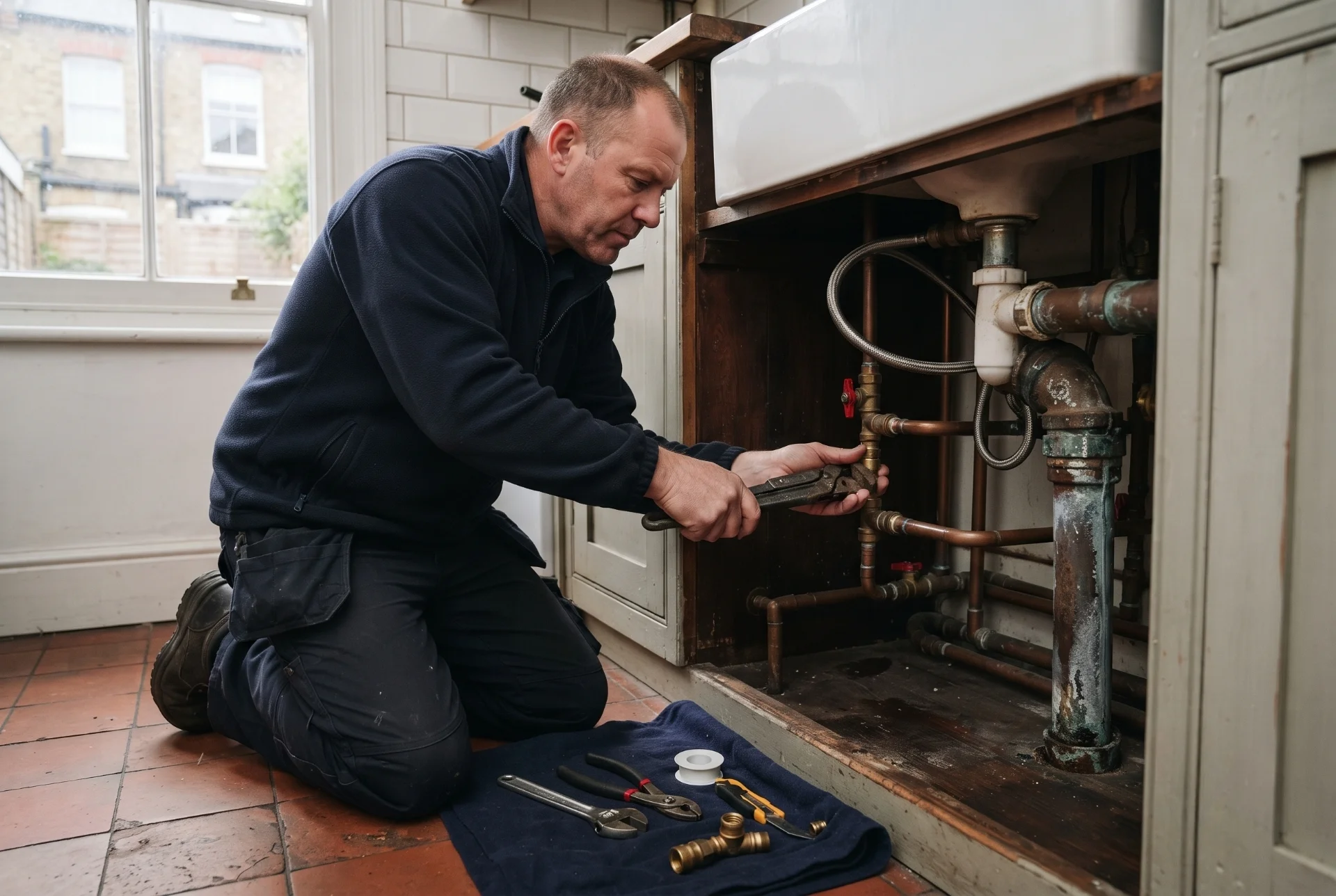
Plumber working on a London plumbing job
On site with a vetted plumber — same specialist you spoke to on the video call
The process
How booking a plumber through Seven works
Designed to solve the most common plumbing booking problem — arriving to find the job is not what was described.
1
Submit your request
Describe the plumbing issue through the app or website. Include where the problem is, what you can see, and how long it has been present. Photos can be attached directly — a picture of a damp patch, a dripping fitting, or the area around the blockage narrows the diagnosis significantly.
2
Free video consultation
A vetted, Watersafe registered plumber joins a live video call with you. For plumbing, this is particularly valuable — you show them the symptom (the leak, the damp, the blocked drain) and they can see the broader context: what type of pipework is visible, what the property type suggests, and whether the issue requires a specialist or can be resolved with a standard visit. Most plumbing issues can be scoped and quoted in 10–15 minutes on a video call.
3
Agree scope and price
The plumber confirms what work is needed, what parts will be required, and what the total cost will be. This agreement is made before the visit — so there are no conversations on the doorstep about whether the quote covers this or that.
4
Job completed
The plumber arrives prepared — with the correct parts and the correct tools for the confirmed scope of work. For notifiable work such as an outside tap installation or a larger replumb, the required notification to Thames Water is handled as part of the job.
5
Rate and review
After completion, you rate the professional through the platform. All reviews are verified against completed bookings — so the ratings reflect genuine jobs, not selected testimonials.
Get instant quotes on your phone
Browse verified plumbers with real ratings and Watersafe registration checks. Book a free video consultation directly from the app.
Browse professionals
View verified Watersafe credentials, real ratings, and completed job history before you choose.
Free video consultation
Book a video call directly from the app — no phone tag or email chains.
Real-time job tracking
Follow your job from quote to completion with status updates.
Instant quotes
Describe your plumbing issue and receive transparent pricing from multiple plumbers.
Barking & DagenhamBarnetBexleyBrentBromleyCamdenCity of LondonCroydonEalingEnfieldGreenwichHackneyHammersmith & FulhamHaringeyHarrowHaveringHillingdonHounslowIslingtonKensington & ChelseaKingston upon ThamesLambethLewishamMertonNewhamRedbridgeRichmond upon ThamesSouthwarkSuttonTower HamletsWaltham ForestWandsworthWestminster
Where London plumbing is most complex
Inner-London boroughs with the highest concentration of Victorian and Edwardian housing stock — Hackney, Islington, Southwark, Lewisham, Lambeth, Tower Hamlets, and Haringey — consistently present more complex plumbing conditions than outer London. The reasons are specific:
Lead supply pipes. Properties built before 1970 in these boroughs frequently retain the original lead communication pipe from the street into the property. Thames Water's Lead Pipe Replacement Scheme covers the external section; the internal section from the stop tap inward is the homeowner's or landlord's responsibility.
Shared drainage. Converted Victorian terraces — now constituting a significant proportion of the rental stock in Hackney, Islington, and Southwark — often share a single soil stack between multiple flats. Blockages and maintenance in these systems require coordination between landlords, which is frequently the cause of delays in repair.
Due diligence
What to check before hiring a London plumber
Most plumbing work does not require a registered professional by law — which means the quality of unregistered work varies significantly. These checks take under five minutes.
For any work connected to the mains water supply, check Watersafe registration at watersafe.org.uk — this confirms the plumber is trained to comply with the Water Supply (Water Fittings) Regulations 1999.
For any work involving gas — including boiler connections or gas supply isolation — confirm Gas Safe registration at gassaferegister.co.uk. This is a legal requirement, not a preference.
For unvented hot water cylinder installation or servicing, confirm the engineer holds a G3 qualification — ask for the qualification certificate specifically, not just a verbal confirmation.
Confirm the plumber carries public liability insurance of at least £1 million before any work begins — particularly for jobs involving water supply pipework where a failure could cause significant property damage.
For notifiable works under the Water Supply (Water Fittings) Regulations (including outside taps, new supply connections, and larger replumbing), confirm the plumber will handle the Thames Water notification as part of the job.
Get the quote in writing before work begins — including labour, parts, and VAT where applicable. A verbal quote is not a fixed price.
For larger jobs (replumbing, bathroom installation), agree a payment schedule with a final payment on satisfactory completion — not full payment upfront.
If the property is a leasehold flat, check whether the lease requires the freeholder's or managing agent's consent before starting any plumbing work that affects shared services or structural elements.
Plumbing job completed and signed off
Fixed price agreed up front, work signed off on completion — no surprises
Expert guidance
Practical plumbing advice for London homeowners and landlords
Know where your stopcock is — before you need it
One of the most consistently overlooked aspects of property ownership in London is the location and condition of the internal stopcock. In a plumbing emergency, every second the water is running is potential damage. In Victorian terraces, the stopcock is typically under the kitchen sink or in a utility cupboard; in purpose-built flats, it may be in a communal riser cupboard. Test yours annually — if it doesn't turn or doesn't fully stop the flow, it needs replacing before an emergency makes that an urgent conversation.
Lead pipes and London water — the honest picture
London's mains water is among the hardest in England — which creates a partial natural protection against lead dissolution, as calcium carbonate deposits line the inside of lead pipes and reduce direct water contact. However, this protection is not complete, is not uniformly distributed, and is not a reason to retain lead supply pipes indefinitely. Thames Water recommends replacement, and will replace the section under the road at no cost to the homeowner. Replacing the internal section is a straightforward job for a Watersafe registered plumber and permanently removes the risk.
Shared soil stacks in converted flats
A recurring source of disputes in London Victorian terrace conversions is the shared soil stack — a single vertical waste pipe serving multiple flats. When this blocks, it affects all flats simultaneously, but the fault often originates in one flat's drainage. Landlords managing converted terraces in Hackney, Islington, or Southwark should establish in advance how shared drainage maintenance is handled — ideally with a written agreement between all leaseholders or a clause in the building's service charge framework — so that when it fails, the response is not delayed by a disagreement about who pays.
Time bathroom work with other trades
A bathroom installation is inherently multi-trade — plumbing, tiling, and often electrical work. The sequencing matters: the plumber installs the rough-in pipework first; the tiler works after waterproofing but before sanitaryware is fitted; the plumber returns for the second fix (connecting sanitaryware). An electrician may be needed for extraction fans, heated towel rails, and shaver sockets. Booking all trades through a single platform — rather than coordinating three separate contractors independently — reduces scheduling conflicts significantly.
When a plumber can't help and who can
Three situations where a plumber is the wrong starting point: (1) The boiler is not heating or firing — this is a gas engineering issue requiring a Gas Safe registered engineer. (2) The hot water cylinder is overheating or the pressure relief valve is discharging — this requires a G3 qualified engineer, not a general plumber. (3) The problem appears to be with the mains supply pipe under the road — contact Thames Water directly, as this is their responsibility. A brief video consultation can confirm which starting point is correct before any professional is dispatched.
Boiler pressure and hidden leaks
A sealed central heating circuit that repeatedly loses pressure is one of the most common reasons landlords and homeowners call a plumber. The first step — adding water through the filling loop to restore pressure — is not a fix; it is a temporary measure that masks a leak. A leak in a sealed heating circuit can be in a radiator valve, a radiator joint, an underfloor heating pipe, or at the boiler itself. The correct approach is to pressure test the circuit to confirm there is a leak, then isolate its location before opening any structure. Video consultation is well-suited to this: the plumber can guide the customer through a simple pressure test and assess whether the loss rate indicates an urgent leak or a gradual release.
Plumbers available now
Talk to a vetted London plumber for free
Free video consultation before any callout. Describe your issue, confirm the plumber's credentials, and agree a fixed price — before anyone travels to your property.
Answers to the questions London homeowners and landlords ask most about plumbing.
For most standard plumbing work, there is no legal requirement to use a registered plumber. However, any work involving gas supply must be carried out by a Gas Safe registered engineer. Work on unvented hot water systems (pressurised cylinders) must be done by a G3-qualified engineer under Part G of the Building Regulations. For all work connected to the public water supply, using a Watersafe or WIAPS registered plumber is strongly advisable — they are trained in the Water Supply (Water Fittings) Regulations 1999, which carry legal force and affect the validity of home insurance.
The Water Supply (Water Fittings) Regulations 1999 set legally binding standards for the design, installation, and maintenance of all plumbing connected to the public water supply in England and Wales. The regulations are enforced by water undertakers — Thames Water in London. Their purpose is to prevent contamination, waste, and misuse of the public water supply. Certain works are \u201cnotifiable\u201d under the regulations and must be reported to Thames Water before they begin. Non-compliant work can result in enforcement action and may invalidate home insurance.
London plumbers typically charge £80–£130 per hour, with most jobs involving a minimum charge of one to two hours. Fixed-price jobs vary considerably: a tap repair might cost £80–£200, a basic drain clearance £85–£250, and a full replumb of a three-bedroom house £4,000–£12,000. Victorian properties with lead pipework, solid masonry walls, or poor access consistently cost more than equivalent work in newer stock. A free video consultation produces a realistic scope and price estimate before any visit is committed.
Lead pipework can leach lead into drinking water — particularly in soft water areas. London's water is relatively hard, which provides partial natural protection through calcium carbonate lining inside the pipe. However, this protection is not complete, varies across London, and is not a reason to retain lead pipework indefinitely. Thames Water recommends replacement and will replace the external section (under the road) at no cost. The internal section from the stop tap into the property is the homeowner's responsibility. A Watersafe registered plumber can replace this as a straightforward job.
Signs of a hidden leak include: an unexplained increase in water bills; damp patches on walls or ceilings with no obvious visible source; the sound of running water when all taps are closed; or a water meter that continues to move when all outlets are shut. To check the meter: turn off all taps and water-using appliances; read the meter; wait 30 minutes without using any water; read the meter again. If it has moved, water is flowing somewhere. A video consultation can help narrow down the likely location before specialist leak detection equipment is deployed.
G3 is a qualification under Part G of the Building Regulations, required for any work on unvented hot water systems — pressurised cylinders such as Megaflo, Vaillant uniSTOR, and similar. Unvented cylinders store water at high pressure and temperature; incorrect installation or servicing creates a risk of explosion or vessel failure. Only G3-qualified engineers are legally authorised to install, commission, or service these systems. G3 is a separate qualification from general plumbing registration — always confirm this specifically before booking any unvented hot water work.
Under the Water Supply (Water Fittings) Regulations 1999, notifiable works in London include: installation of a new supply pipe or extension to an existing one; connection of a bidet with upward-facing spray; installation of a garden tap or hose union tap; installation of a pond or swimming pool supplied from the mains; and certain commercial or larger-scale plumbing installations. Notifiable works must be reported to Thames Water before they begin. A Watersafe registered plumber handles this notification as standard — an unregistered plumber may not know it is required.
A sealed heating circuit that repeatedly loses pressure almost always has a leak somewhere in the system. This can be in a radiator valve, a radiator joint, an underfloor heating pipe, at the boiler's heat exchanger, or at the pressure relief valve. Diagnosing the source requires pressure testing the circuit, which can be done by a plumber or a Gas Safe engineer depending on where the suspected leak is. A brief video consultation — where the customer is guided through checking radiator valves and visible pipework — often identifies the starting point before any professional visit.
No — not legally. Any work on a gas-fired boiler, including repair and servicing, must be carried out by a Gas Safe registered engineer. A plumber can work on the water circuit connected to the boiler — radiators, pipework, and the filling loop — but cannot touch the gas components. If your boiler is not firing or is producing fault codes, the correct starting point is a Gas Safe registered engineer, not a plumber. The Seven Services boiler and heating service covers this category separately.
A full replumb of a two-bedroom London flat typically takes 3–6 days; a three-bedroom house takes 5–10 days. Period properties with solid masonry walls, solid floors, or listed building constraints take longer — cable routing options are limited and more careful work is required to avoid damaging existing fabric. The property should be vacated during the replumb, and redecoration is usually required after. Where possible, scheduling the replumb alongside a kitchen or bathroom renovation reduces the total disruption significantly.
Watersafe is a UK quality assurance scheme for plumbers and heating engineers who are trained and assessed in the requirements of the Water Supply (Water Fittings) Regulations 1999. Registration confirms that the plumber understands and works to the legal standard for water fittings installations in England and Wales. WIAPS (Water Industry Approved Plumber Scheme) is an equivalent scheme. Searching for a plumber on watersafe.org.uk confirms they are currently registered — it is always worth checking directly rather than relying on self-declaration.
A drain that blocks once and is cleared with rods or jetting does not necessarily need a CCTV survey. A drain that blocks repeatedly — particularly at the same location, or with the same material — almost always has a structural problem that clearing alone will not resolve. Common structural causes in London include tree root ingress (particularly near the mature street trees common in inner-London boroughs), a collapsed section of Victorian clay drainage, or a belly in the drain run. A CCTV survey identifies the precise cause and location, producing a report that enables targeted repair rather than repeated clearing.
An outside tap installation is notifiable work under the Water Supply (Water Fittings) Regulations 1999 and requires a double-check valve to prevent backflow contamination. While there is no legal requirement for a registered plumber to carry out this work, the installation must comply with the regulations, and the work must be notified to Thames Water. A plumber who is not Watersafe registered may be unaware of this requirement — which creates a legal risk for the homeowner if the installation is later found to be non-compliant.
Low pressure affecting all outlets in a flat typically has one of three causes: a partially closed or seized stopcock; a failing pressure reducing valve (PRV); or an undersized or scaled supply pipe. In converted Victorian terraces, a common cause is that the original supply pipe — sized for single-occupancy use in the late 19th century — is now serving multiple flats, creating insufficient flow for modern demand. Low pressure at only one outlet (a single tap or shower) usually indicates a blocked aerator, a failing shower cartridge, or a partially closed isolation valve at that fitting.
Banging or knocking in pipes — water hammer — is caused by a pressure surge when a water flow is suddenly stopped. In London properties with high mains pressure, this can be significant. Solutions depend on the cause: if it occurs only when the washing machine or dishwasher valve closes, a water hammer arrestor on the appliance supply is typically sufficient. If it occurs on multiple outlets, a pressure reducing valve on the incoming supply reduces the baseline pressure throughout the system. If the pipes are simply loose and vibrating against structure, mechanical securing resolves the noise without needing hydraulic intervention.
Yes. Under the Landlord and Tenant Act 1985 (Section 11), landlords of residential properties in England are legally required to maintain the water supply, drainage, sanitary installations, and heating and hot water systems in good repair and working order. A failure of the toilet or hot water supply must be repaired within a reasonable time — and in the case of total loss of hot water or a blocked or non-functioning toilet, \u201creasonable\u201d is a matter of days, not weeks. Failure to repair constitutes a breach of the tenancy agreement and may entitle the tenant to compensation or the right to carry out and recharge the work.
A plumber works on the water supply and drainage systems — taps, pipes, waste, drains, bathrooms, and cold water supply. A heating engineer works on heating systems — radiators, underfloor heating, heat pumps, and the water circuit of the central heating system. A Gas Safe registered heating engineer also works on the gas supply and gas-fired appliances. Many professionals in London hold both plumbing and heating qualifications. For a boiler fault, always start with a Gas Safe registered engineer. For a leak, blockage, or supply issue, start with a plumber.
A plumber can work on the water circuit of a wet underfloor heating system — the manifold, the pipework connections, and the flow and return connections to the boiler or heat pump. Electric underfloor heating is an electrical installation and must be worked on by a Part P registered electrician. Diagnosing a fault in a wet UFH system — pressure loss, a zone that is not heating, or a visible leak — is well-suited to a video consultation, where the plumber can assess the manifold and visible pipework before visiting.
A bathroom installation in London typically costs £3,000–£8,000 for a standard family bathroom, and up to £14,000+ for a larger or higher-specification bathroom with bespoke tiling, premium sanitaryware, or a wet room conversion. The cost reflects multiple trades — plumbing, waterproofing, tiling, and usually electrical work. In Victorian properties with solid floors, the cost of accessing and replacing waste pipework buried under a concrete screed significantly increases the plumbing element compared to properties with suspended timber floors.
Immediately close the stopcock — this stops the water flow and limits damage. Know where your stopcock is before an emergency. Then isolate the electricity in the affected area if water is near electrical fittings. Open taps to drain the pipes. Contact your insurer and a plumber. If the burst is on a supply pipe outside your property boundary (on the street), contact Thames Water rather than a plumber. If the property is a leasehold flat and the burst is in shared pipework or a service riser, notify the managing agent or freeholder immediately — they are responsible for shared services.
In a leasehold property, responsibility for a leak and the resulting damage depends on where the leak originates and the terms of the lease. Generally, the leaseholder whose property contains the source of the leak is responsible for the repair and for any resulting damage — even if the water has travelled into an adjacent flat. Buildings insurance (usually held by the freeholder and paid through the service charge) typically covers structural damage; contents insurance covers personal belongings. If the leak is from a communal pipe or service riser, the freeholder is responsible. This is a common and complex area — a solicitor's or managing agent's advice is sometimes needed alongside the plumber.
A dishwasher that connects to an existing supply and waste connection under the kitchen sink does not require a plumber — this is a straightforward DIY task or an appliance engineer job. A plumber is needed if a new dedicated supply connection or a new waste run is required — for example, when installing a dishwasher in a kitchen island, or where the existing connections cannot be extended. A brief video consultation will confirm whether your specific installation requires a plumber or not.
What customers say
London homeowner & landlord reviews
Reviews from verified Seven Services bookings — plumbing jobs across London.
"The video call diagnosed the problem in about eight minutes — a failed compression joint under the bathroom floor, not a leak from the visible fitting above. The plumber arrived with the right parts and got it done in an afternoon. No second trip."
Mark T.
Leak repair · Hackney
"I manage a portfolio of HMOs in Southwark and the shared soil stack in one of my properties blocks every few months. Seven's plumber did a CCTV survey and found a root intrusion about four metres down the run. One targeted repair, problem solved — instead of just clearing it again."
Priya N.
CCTV drain survey & repair · Southwark
"Victorian terrace in Lewisham — lead service pipe all the way to the street. The plumber knew the Thames Water scheme, handled the notification, and the whole thing was coordinated within a week. Straightforward once I had someone who actually knew the process."
Claire B.
Lead pipe replacement · Lewisham
"The video consultation showed the plumber my stopcock situation before any visit — it had completely seized. He quoted the job precisely and turned up with a replacement. Knowing my stopcock now actually works is genuine peace of mind."
James O.
Stopcock replacement · Islington
"Bathroom installation in a first-floor Victorian flat in Wandsworth — solid concrete floor, which I knew would complicate the waste. The plumber and tiler were coordinated through Seven, the sequencing was handled properly, and the end result was exactly what was quoted."
Sophie K.
Bathroom installation · Wandsworth
"Recurring boiler pressure drop that nobody had been able to trace. The Seven plumber pressure tested the circuit systematically rather than just topping it up. Found a pinhole leak in a radiator tail that had been painted over by a decorator. Fixed in an hour."
What: Plumbing installation, repair, and maintenance services for residential and commercial properties across Greater London, covering water supply, drainage, sanitary installations, and heating water circuits.
Who needs it: Homeowners (leaks, blocked drains, bathroom installation), landlords (statutory repair obligations under Section 11, Landlord and Tenant Act 1985), and property buyers (pre-purchase assessment of Victorian pipework).
Key compliance points: All plumbing connected to the public water supply must comply with the Water Supply (Water Fittings) Regulations 1999. Certain works are notifiable to Thames Water before they begin. Unvented hot water systems require a G3-qualified engineer under Part G of the Building Regulations. Gas-related work requires Gas Safe registration.
Typical London costs: Hourly rate £80–£130; leak repair £100–£450; drain clearance £85–£350; outside tap £150–£400; full replumb (3-bed house) £4,000–£12,000; bathroom installation £3,000–£14,000.
Seven Services: Marketplace platform connecting London homeowners and landlords with vetted, Watersafe registered, fully insured plumbers across all 32 boroughs. Includes a free video consultation before any callout — for diagnosis, scoping, and fixed-price agreement before travel costs are incurred.
This page is intended for general informational purposes. Plumbing work connected to the public water supply should be carried out in compliance with the Water Supply (Water Fittings) Regulations 1999. Gas-related work must be carried out by a Gas Safe registered engineer. Unvented hot water system work requires a G3-qualified engineer. Regulatory requirements cited reflect the law in England; requirements may differ in Wales, Scotland, and Northern Ireland. Prices are indicative market ranges and will vary depending on property specifics, scope, and contractor. Seven Services connects customers with independent tradespeople and does not carry out work directly.