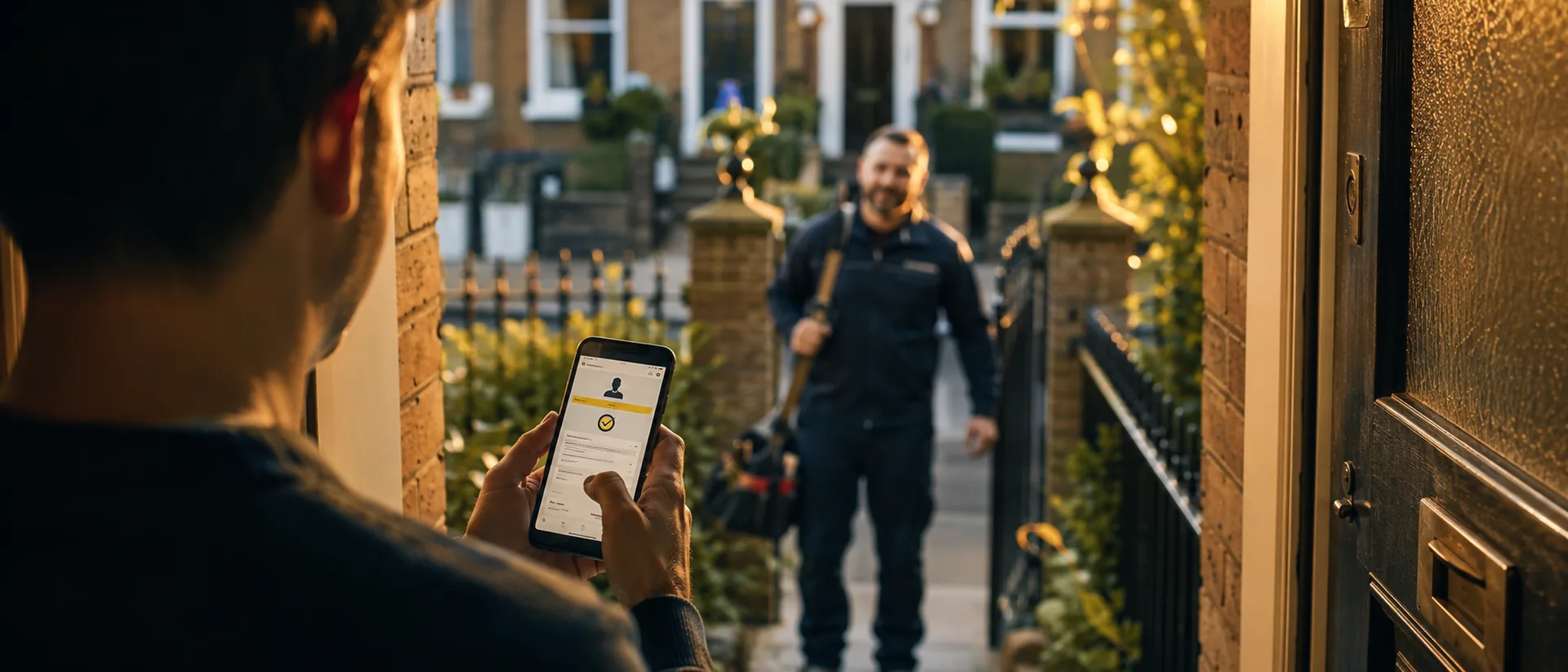
This article provides general guidance only and is not a substitute for professional advice specific to your property or circumstances. For any work involving gas, electrics, or structural elements, always engage a qualified, registered professional in person.
Why Vetting Matters More in London
London's property market creates specific conditions that make vetting tradespersons more consequential than almost anywhere else in the UK. The density of demand — millions of properties, thousands of daily maintenance jobs across 32 boroughs — means there is no shortage of people willing to take on work. What varies enormously is whether they are qualified, insured, and legally permitted to do it.
The consequences of getting this wrong are not abstract. In London, unregistered gas work has caused carbon monoxide incidents. Electrical installations completed without proper Part P certification have invalidated home insurance policies during claims and caused problems on resale — leaving homeowners liable for remediation costs they had not anticipated. Structural work on Victorian terraces carried out by unqualified contractors has caused damage that took months and tens of thousands of pounds to put right. The regulatory framework that governs trade work in the UK exists precisely because the risks are real, and it is the homeowner who bears them if they hire without checking.
There is also a straightforward personal safety dimension. You are letting someone you do not know into your home, often when you are alone or have family present. Checking credentials before anyone arrives is not excessive caution — it is basic due diligence, and in most cases it takes a matter of minutes.
Match the Certification to the Trade
Different trades carry different regulatory requirements in the UK, and the certifications that matter vary accordingly. Understanding which to ask for — and how to verify them — is the first practical step.
Gas work is the most tightly regulated domestic trade in the UK. Anyone working on gas appliances, boilers, or pipework must be registered with Gas Safe Register. This is a statutory requirement under the Gas Safety (Installation and Use) Regulations 1998 — not a voluntary accreditation. Every registered engineer has a unique licence number and carries a Gas Safe ID card with their photo, registration number, and the categories of gas work they are qualified to carry out. You can verify any engineer's registration instantly on the Gas Safe Register website, free of charge, before booking. For any boiler servicing, repair, or gas work in your London property, this check is non-negotiable.
Electrical work that falls under Part P of the Building Regulations — which includes new circuits, consumer unit replacements, additions to existing circuits in kitchens and bathrooms, and installation of fixed outdoor wiring — must either be carried out by a registered competent person or be inspected and certified by your local authority building control after the fact. The main competent person schemes for electricians in England are NICEIC, ELECSA, and NAPIT. An NICEIC-registered electrician, for example, can self-certify their own notifiable work; without that registration, they cannot. Always ask to see their scheme membership certificate before work begins, and expect to receive an Electrical Installation Certificate on completion of any notifiable job.
Plumbing does not currently carry the same statutory registration requirements as gas or electrical work, though this is a topic of ongoing regulatory discussion. Reputable London plumbers will often hold WaterSafe accreditation for work affecting the mains water supply, or be members of the Chartered Institute of Plumbing and Heating Engineering (CIPHE). These signal professional standards rather than legal requirements, but they are meaningful filters. For any plumbing work that involves the mains supply pipework, checking WaterSafe registration takes under a minute and eliminates a meaningful proportion of less reliable operators.
Handyman and general property work — painting, tiling, carpentry, flat-pack assembly, minor repairs — operates without a trade-specific statutory certification scheme. The vetting criteria here shift to identity verification, public liability insurance, and verifiable reviews from people who have actually paid for the work. A good London handyman will still be entirely comfortable producing insurance documents and references even without a formal trade certificate to show.
Checking Public Liability Insurance
Every tradesperson working in your home should carry public liability insurance. This covers damage to your property and injury to third parties — including you — caused by their work or negligence. Without it, if a plumber's poor connection floods your kitchen or an electrician's wiring causes a fire, you may be left pursuing them personally through the courts. For sole traders with limited assets, this can result in recovery that falls far short of your actual losses.
The correct approach is to ask for proof of insurance before work begins — not after. A credible tradesperson will have a certificate of insurance they can share, either as a physical document or a PDF. The policy should clearly name them or their trading company. The coverage amount should be appropriate for the scale of work: a minimum of £1 million public liability coverage is the expected baseline for domestic trade work in London, and £2 million or above is common for jobs involving structural elements, significant plumbing changes, or anything where a single incident could cause major consequential damage.
Be sceptical of vague responses. "I'm covered, don't worry" is not the same as showing you a valid, in-date certificate. A tradesperson who is reluctant or unable to produce one should be treated as uninsured until demonstrated otherwise — and that alone is a legitimate reason not to proceed.

Every Seven Services professional is identity-verified, trade-certified, and insured before joining the platform. Free video consultation before any visit.
How to Read Reviews Without Being Fooled
Online reviews have become the primary decision-making tool for London homeowners hiring tradespeople — and a primary target for manipulation. Understanding which reviews carry genuine weight is a genuinely useful skill.
Platform-verified reviews — those tied to confirmed bookings or completed payments — carry significantly more weight than open text fields that anyone can submit. A review that references specific details of the job (the type of boiler serviced, the borough where the work took place, a specific problem that was diagnosed and resolved) is far more credible than a generic positive statement. The specificity signals that the reviewer is describing a real experience rather than providing a courtesy endorsement or, in some cases, a paid one.
Pay attention to how the tradesperson handles negative reviews. A professional who responds calmly, acknowledges a genuine issue, and describes what they did to put it right is demonstrating more about their character than a page of five-star ratings without nuance. Conversely, a tradesperson who responds to criticism defensively, dismissively, or by disputing the reviewer's account should prompt scepticism about how they will handle any issues that arise during your job.
For London-specific work, look for reviewers who mention your borough or property type. A plumber with consistent reviews from customers in Islington, Hackney, or Lewisham for Victorian terrace work — properties with their particular combination of older pipework, raised ground floors, and tight access — is a different proposition from someone with generic reviews from across England.
Every professional on Seven Services is identity-verified, trade-certified, and insured before they can accept a job. Get a free video consultation and 15% off your first request — no vetting legwork required.
Red Flags That Should Make You Walk Away
Experienced London homeowners develop a feel for warning signs over time. The following patterns recur consistently enough to treat as reliable indicators of risk rather than one-off coincidences.
- Cash-only requests: Legitimate tradespeople accept card payments and provide VAT invoices where applicable. A cash-only insistence, particularly combined with pressure to pay before work is complete, suggests someone operating outside the standard commercial framework — and outside the paper trail you could rely on in any dispute.
- No verifiable business address: A tradesperson with only a mobile number and no consistent business address or online presence is harder to trace if something goes wrong. Most legitimate sole traders operating in London have at least a verifiable address and a stable digital footprint, even if they are a one-person operation.
- Refusal to put a quote in writing: Any professional doing meaningful work in your home should be willing to specify the scope and cost in writing before starting. Verbal agreements are practically unenforceable, particularly in London's busy trade environment where misunderstandings are genuinely common.
- Pressure to start immediately: "I happen to be nearby, I can start this afternoon" is sometimes genuinely convenient and sometimes a tactic designed to bypass your due diligence process. If you feel rushed before you have had time to check credentials and review the written quote, slow down — a day's delay is always worth it.
- Unexplained substitution on arrival: If a different person shows up than the one you booked and vetted, ask immediately for their credentials. Legitimate subcontracting does happen in the trade, but you should have been informed in advance, and you have every right to verify that the substitute holds the same qualifications.
Questions to Ask Before Anyone Arrives
A short conversation before any booking — or, increasingly, a video call — gives you an opportunity to assess a tradesperson's knowledge and professionalism before they set foot in your home. The Seven Services platform includes a free video consultation as the first stage of every booking, which lets you describe the problem directly to the matched professional, ask your due diligence questions, and make a properly informed decision before committing to a visit.
For any trade, useful pre-booking questions include: What is your experience with this type of property and this specific job? Are you registered with Gas Safe, NICEIC, or the relevant scheme for this work? Can you send through proof of public liability insurance before the appointment? What exactly does your quote include, and what circumstances — if any — might cause the final price to change? What are the completion criteria, and how will the work be signed off?
The answers matter, but the manner in which they are given often matters more. A tradesperson who explains their process clearly, does not become evasive when asked about credentials, and offers to send documentation without being prompted is signalling professional standards before the job has even started. Evasiveness at the conversation stage is a reliable predictor of evasiveness when things get difficult.

Get Everything in Writing Before Work Starts
A written quote is the document that defines the agreement between you and the tradesperson. A properly structured quote should include the full scope of work, the specific materials to be used and who is responsible for supplying them, a clear price with VAT stated separately if applicable, the expected timeline, and any conditions that could legitimately affect the final cost — such as concealed damage discovered once a wall is opened.
If the scope changes after work begins, any additions or alterations should be agreed in writing before the additional work proceeds. This is particularly relevant in older London housing stock — Victorian terraces, Edwardian mansion blocks, 1960s conversions — where opening up walls, floors, or ceilings can reveal surprises that could not have been priced accurately from the surface. A professional tradesperson will pause, explain what they have found, and obtain your written agreement before proceeding. One who simply continues and presents a higher invoice afterwards has not acted in accordance with best practice.
Keep all documentation: the original quote, any scope amendments, receipts, payment confirmations, and any certification issued on completion — Gas Safety Certificates, Electrical Installation Certificates, Building Regulations completion notices. For London homeowners who sell eventually, this paperwork forms part of the property's compliance history and will be requested during conveyancing.
How Seven Services Handles the Vetting For You
The vetting process described in this article is thorough, but it requires time, trade knowledge, and a degree of confidence in knowing what to ask and what the answers should look like. Seven Services was built specifically to remove that burden from London homeowners.
Every professional on the platform has completed identity verification, trade qualification checks appropriate to their category — Gas Safe for boiler engineers, Part P scheme membership for electricians — and public liability insurance verification. Right-to-work status in the UK is also confirmed as a condition of joining the platform. These are baseline requirements, not optional steps.
The feature that most directly addresses the anxiety of letting a stranger into your home is the free video consultation that precedes every on-site visit. Rather than inviting someone into your home based only on a profile and a set of star ratings, you have a direct conversation — via video call — with the specific tradesperson matched to your request. You describe the problem, see how they communicate, ask your questions, and assess their knowledge in real time. If you are not satisfied, you are under no obligation to book the visit. The callout only happens if you choose to proceed.
This approach changes the dynamic of hiring a London tradesperson fundamentally. Instead of making a decision based on credentials alone — which you can now verify through the platform — you are making it based on a genuine interaction with the person who will do the work. That is a meaningfully different level of confidence than reading a profile page, and it is exactly the standard we apply to every handyman booking made through Seven Services.
Frequently Asked Questions
How do I check if a gas engineer is registered in London?
All gas engineers working on boilers, gas appliances, or pipework in the UK must be registered with Gas Safe Register. You can verify any engineer at no cost using the Gas Safe Register website — search by their licence number, name, or postcode. This is a legal requirement, not an optional accreditation, and it applies to all gas work across London regardless of property type or size.
What certifications should a London electrician have?
For notifiable electrical work — including new circuits, consumer unit replacement, and additions to circuits in bathrooms — your electrician should be registered with a competent person scheme such as NICEIC, ELECSA, or NAPIT. This allows them to self-certify their work under Part P of the Building Regulations. Always ask for their scheme membership certificate before work begins, and request an Electrical Installation Certificate on completion.
Do I need to see a tradesperson's insurance before they start work in my London home?
Yes. Any tradesperson working in your London home should be able to provide a current public liability insurance certificate before work begins. A minimum of £1 million coverage is standard for most domestic trade work, with £2 million or above common for larger jobs. If a tradesperson is unable or unwilling to provide proof of insurance, that alone is sufficient reason not to proceed.
What are the warning signs of an unreliable tradesperson in London?
Key warning signs include: insisting on cash payment only, being unable to provide a written quote before starting work, refusing to show certification or insurance documents, arriving as an unannounced substitute for the person you originally vetted, applying pressure to start immediately without giving you time to review their credentials, and having no verifiable business address or consistent online presence.
Can I speak to a tradesperson before booking a visit to my London home?
Yes. Seven Services offers a free video consultation with a vetted London tradesperson before any on-site visit is booked. You describe the problem via video call, see how the professional communicates, and can ask any credential or scope questions — without committing to a callout. If you choose to proceed, the on-site visit is then booked. There is no obligation if you are not satisfied.
What: A practical guide to vetting a London tradesperson before letting them into your home — which certifications to check per trade, how to verify insurance, how to read reviews, red flags to watch for, and the questions to ask before booking.
Certifications by trade: Gas work requires Gas Safe Register membership (statutory, verifiable free online); notifiable electrical work under Part P requires NICEIC, ELECSA, or NAPIT registration; plumbing has no statutory scheme but WaterSafe or CIPHE membership signals professional standards; handyman work relies on identity verification, insurance, and verifiable reviews rather than a trade certificate.
Insurance requirement: Every tradesperson should carry public liability insurance — minimum £1 million for standard domestic work, £2 million or above for larger jobs — and should produce a current certificate before work begins.
Red flags: Cash-only demands, no verifiable business address, refusal to quote in writing, pressure to start immediately, and unexplained substitution of the tradesperson on arrival are all reliable warning signs.
Get it in writing: A proper quote specifies scope, materials, price with VAT if applicable, timeline, and conditions that could change the price — and any scope changes during the job should be agreed in writing before proceeding.
Seven Services: A London home-services marketplace where every professional is identity-verified, trade-certified, and insured before joining, with a free video consultation before any on-site visit is booked and 15% off a customer's first request.
Skip the vetting process — every Seven professional is identity-verified, trade-certified (Gas Safe, Part P, NICEIC where relevant), and fully insured. Fixed-price quotes in writing before any work begins. Available across all 32 London boroughs.