London Central Heating Engineers Kept Warm, Balanced & Compliant
Vetted, Gas Safe registered heating engineers across all 32 London boroughs. Radiators, powerflushing, underfloor heating, zoning and system repairs — with a free video consultation before any callout.
Gas Safe registeredFully insured4.8 · 176 reviewsAll 32 London boroughs
What does a central heating engineer actually cover?
A central heating engineer works on the system your boiler feeds into — radiators, pipework, powerflushing, underfloor heating, zoning, and thermostatic controls — rather than the boiler unit itself. If your boiler is faulty or needs replacing, a dedicated boiler engineer is the right call. If the issue is cold radiators, patchy heating room to room, a system losing pressure repeatedly, or you're planning underfloor heating or a smart thermostat upgrade, this is heating system work.
Any work that involves disconnecting or altering pipework connected to a gas boiler requires a Gas Safe registered engineer under the Gas Safety (Installation and Use) Regulations 1998. Seven Services verifies Gas Safe registration for every heating engineer carrying out gas-connected work, and every booking includes a free video consultation before any callout. A pattern frequently seen in London's Victorian and Edwardian terraces is cold radiators being misdiagnosed as a boiler fault, when the actual cause is sludge buildup in a system that has never been powerflushed.
At a glance
Central Heating Services — Key Facts
Coverage
All 32 London Boroughs
Certification
Gas Safe Register
Key regulation
Gas Safety Regs 1998 / Part L
Radiator replacement from
£150 fixed price
Powerflush from
£350 fixed price
Underfloor heating from
£600 per room
Booking
App or Web
Video consultation
Free, before any callout
Why Seven Services
What makes our heating engineers different
Heating faults are frequently misdiagnosed as boiler problems. A free video call up front, with a Gas Safe verified engineer, gets you to the right fix faster.
Free video consultation first
A vetted heating engineer assesses your symptoms — cold radiators, pressure loss, noisy pipes — on a live video call before anyone travels to the property. Many system issues can be scoped remotely, saving you a diagnostic callout fee.
Gas Safe verified for gas-connected work
Any work on pipework connected to a gas boiler requires a Gas Safe registered engineer. We verify registration on the official Gas Safe Register before any engineer is listed for gas-connected heating work.
Fully insured on every job
All heating engineers on the platform carry public liability insurance, protecting you if anything is accidentally damaged during radiator, pipework, or underfloor heating work.
Written quotes before any work begins
Scope and price are agreed during the video consultation — before anyone travels. Powerflush inclusions, radiator BTU sizing, and materials are itemised clearly, so there are no surprises once work begins.
All 32 London boroughs covered
From Barnet to Bromley, Hillingdon to Havering — our network covers every borough, with consistent pricing and availability regardless of location.
London property expertise
Solid-wall Victorian and Edwardian houses behave very differently from cavity-wall new-builds when it comes to heat loss and radiator sizing. The engineers on the platform understand these differences and size systems accordingly.
What we cover
Central heating services available in London
System-level heating work — everything the boiler feeds into. For boiler unit installation, repair, or replacement, see our dedicated boiler engineer page.
Not sure whether your issue is boiler-related or a wider heating system problem? A free video call with a vetted heating engineer can confirm the right approach before anyone visits your property.
Radiator Installation & Replacement
Fitting new radiators, replacing worn or leaking units, and adding radiators to rooms currently without one. Correct BTU sizing matters more in solid-wall London properties than the manufacturer's generic room-size chart accounts for — an experienced engineer will calculate heat loss for the specific room rather than guessing from floor area alone.
1–3 hours per radiator £150–£450 Gas Safe registered (gas-connected)
Powerflushing & System Flush
A powerflush clears years of accumulated corrosion sludge from radiators and pipework, restoring proper circulation and even heat distribution. This is the standard fix for cold spots, patchy heating, and radiators that need frequent bleeding — and is often mistaken for a boiler fault when the boiler itself is working correctly.
4–6 hours (whole system) £350–£650 Gas Safe registered
Thermostats & Smart Heating Controls
Installing smart thermostats, thermostatic radiator valves (TRVs), and programmable controls that let you manage heating room by room. A genuinely cost-effective upgrade for larger London houses where uniform whole-house heating wastes energy in unused rooms.
Electric underfloor heating mats (more straightforward to retrofit, no boiler connection needed) or wet underfloor heating systems connected to the central heating (better suited to full renovations with floor buildup available). Both options work in London properties — the right choice depends on the scope of the wider works.
1–3 days per room £600–£2,800 per room Gas Safe registered (wet systems)
Zoning & Multi-Zone Heating Systems
Splitting a heating system into independently controlled zones — useful in larger London houses across multiple floors where a single thermostat leads to some rooms overheating while others stay cold. Involves zone valves, additional wiring, and thermostat placement.
Half day – 1 day £220–£420 per zone Gas Safe registered
Cold Spot Diagnosis & Balancing
Investigating why specific radiators or rooms stay cold while others heat normally — often a balancing issue (flow not evenly distributed across the system) rather than a fault with any single radiator. Correct balancing is frequently skipped after a new boiler install, leaving cold spots that get blamed on the wrong cause.
1–2 hours £80–£160 Gas Safe registered
Central Heating Repairs (Non-Boiler)
Leaking pipework, faulty zone valves, seized radiator valves, and pump issues within the system — distinct from boiler-unit faults. A competent heating engineer diagnoses whether a symptom originates in the boiler or the wider system before quoting a fix.
1–3 hours £90–£280 Gas Safe registered
Annual Heating System Service
A non-boiler-specific system check: pressure testing, radiator bleeding, inhibitor level check, and visual inspection of pipework and valves. Recommended annually, particularly for older systems, to catch developing issues before they cause cold spots or leaks.
1–2 hours £80–£150 Gas Safe registered
Common issues
Heating system problems London homeowners report
Most of these are system issues rather than boiler faults — worth ruling out before assuming the boiler needs attention.
Cold radiators but the boiler seems fine?
A free video call with a vetted heating engineer can often diagnose the cause remotely — no callout fee for the assessment.
A classic sign of sludge buildup inside the radiator from internal corrosion — different from trapped air, which causes cold at the top instead. A powerflush is the standard fix, restoring circulation across the affected radiators.
Radiators need bleeding frequently
If a radiator keeps trapping air even after being bled, this can point to a slow leak elsewhere in the system, a failing expansion vessel, or a pump issue introducing air — worth having checked rather than continuing to bleed it repeatedly.
Noisy pipes or banging (kettling)
Banging or "kettling" noises often indicate limescale or sludge buildup restricting flow, causing localised overheating. Left unaddressed, this can accelerate wear on the affected section of the system.
Uneven heating room to room
Some rooms heat quickly while others stay cold — commonly a balancing issue, where flow through the system isn't evenly distributed. This is frequently overlooked after a new boiler or radiator installation.
System losing pressure repeatedly
A heating system that needs regular repressurising points to a leak somewhere in the pipework, a faulty valve, or occasionally the expansion vessel — worth investigating rather than simply topping up pressure each time.
Black or discoloured water when bleeding radiators
Dark, sludgy water when bleeding a radiator is a clear sign of internal corrosion buildup circulating through the system — this is precisely what a powerflush is designed to clear before it causes further cold spots or pump damage.
Heating is slow to warm the property
A system that takes noticeably longer than it used to reach comfortable temperature can indicate sludge restricting flow, incorrect radiator sizing for the room, or poor balancing — all system-level issues rather than boiler faults.
Pricing guide
How much do central heating services cost in London?
System-level heating work, separate from boiler unit pricing. These are realistic 2026 market ranges.
Unsure what your heating issue should cost to fix?
A free video consultation produces a realistic scope and cost estimate before any visit.
Underfloor heating — wet system retrofit (per room)
£1,200
£1,900
£2,800
Floor buildup available, boiler capacity
Zone valve / zoning upgrade (per zone)
£220
£320
£420
Number of zones, additional wiring
System chemical flush + inhibitor
£180
£250
£320
System size, inhibitor grade
Annual heating system service
£80
£115
£150
Number of radiators, system age
Why cold radiators aren't always a boiler problem
A pattern seen consistently across London's older housing stock: a homeowner books a boiler engineer for cold radiators, only to find the boiler is working correctly and the actual cause is sludge buildup in the system, poor balancing, or a failing zone valve. This matters for cost as much as for the fix — a powerflush (£350–£650) resolves most sludge-related cold spot issues, considerably less than an unnecessary boiler callout followed by a heating engineer visit anyway.
If your boiler is confirmed working correctly (fires up, reaches temperature, no fault codes) but radiators are cold or patchy, the issue is very likely system-level rather than boiler-level.
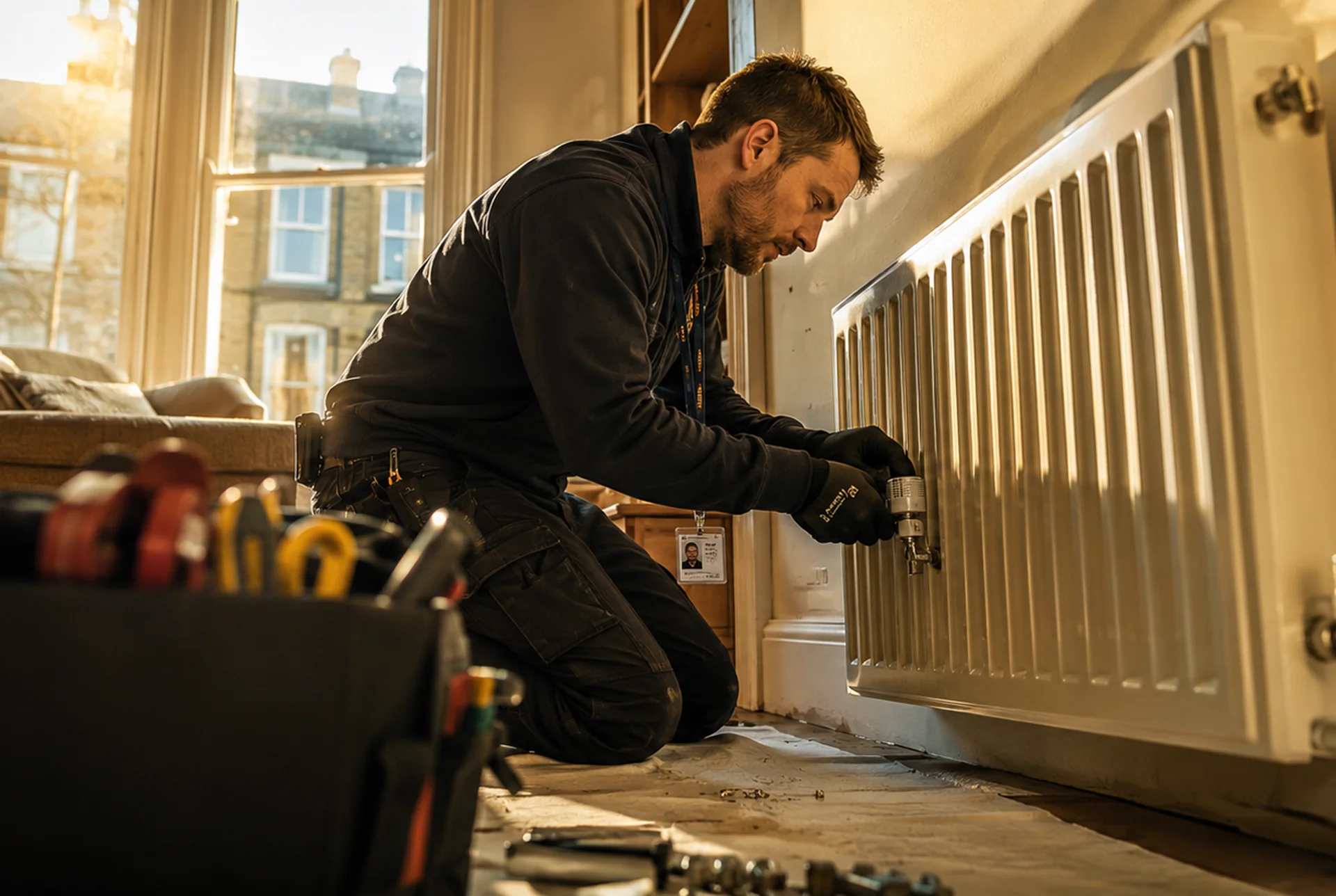
Heating engineer working on a London radiator installation
On site with a vetted heating engineer — same specialist you spoke to on the video call
The process
How booking a heating engineer through Seven works
Designed to correctly diagnose boiler-vs-system issues before committing to a callout.
1
Submit your request
Describe your heating symptoms through the app or website — which radiators are affected, whether the boiler itself seems to be working, and any noises or pressure issues you've noticed. Photos of the boiler pressure gauge and affected radiators help.
2
Free video consultation
A Gas Safe registered heating engineer joins a live video call to assess your symptoms. Many system issues — cold spots, balancing problems, pressure loss patterns — can be diagnosed or at least narrowed down significantly before anyone visits.
3
Agree scope and price
The engineer confirms what's involved — a powerflush, radiator replacement, rebalancing, or a repair — and provides a written quote before the visit, so there's no doorstep negotiation about scope.
4
Work completed
The engineer arrives with the tools and, where agreed in advance, the materials needed. Gas-connected work is carried out and signed off in line with Gas Safe requirements.
5
Rate and review
After completion, you rate the professional through the platform. All reviews are verified against completed bookings.
Get instant quotes on your phone
Browse verified heating engineers with real ratings and Gas Safe registration checks. Book a free video consultation directly from the app.
Browse professionals
View verified Gas Safe credentials, real ratings, and completed job history before you choose.
Free video consultation
Book a video call directly from the app — no phone tag or email chains.
Real-time job tracking
Follow your job from quote to completion with status updates.
Instant quotes
Describe your heating symptoms and receive transparent pricing from multiple engineers.
Gas Safe registered, insured heating engineers available across the whole of Greater London — consistent availability and pricing regardless of borough.
Barking & DagenhamBarnetBexleyBrentBromleyCamdenCity of LondonCroydonEalingEnfieldGreenwichHackneyHammersmith & FulhamHaringeyHarrowHaveringHillingdonHounslowIslingtonKensington & ChelseaKingston upon ThamesLambethLewishamMertonNewhamRedbridgeRichmond upon ThamesSouthwarkSuttonTower HamletsWaltham ForestWandsworthWestminster
Why solid-wall London properties heat differently
A large share of London's inner boroughs — Hackney, Islington, Lambeth, Lewisham, and Haringey among them — are dominated by Victorian and Edwardian solid-wall construction. These properties lose heat faster than modern cavity-wall homes, which has two practical consequences for heating system design:
Radiator sizing needs recalculating, not assuming. A generic manufacturer room-size chart is calibrated for modern, insulated cavity walls. In an unrenovated solid-wall Victorian property, the same room typically needs a larger radiator to reach the same comfortable temperature.
Zoning has a bigger impact. Tall, narrow London terraces with multiple floors often see significant temperature variation top to bottom. Zoning — splitting the system into independently controlled sections — is disproportionately effective in this housing type compared to a single-storey new-build.
Due diligence
What to check before hiring a London heating engineer
These checks matter particularly for gas-connected work, where compliance isn't optional.
Confirm Gas Safe registration for any work involving pipework connected to a gas boiler — check the engineer's ID card or the online Gas Safe Register.
Ask for proof of public liability insurance before any work begins.
Get a written quote before work begins, including whether a powerflush includes inhibitor dosing and what warranty (if any) applies.
For new radiators, ask whether BTU sizing has been calculated for the specific room, or just estimated from a generic chart.
Confirm TRV compatibility with your existing system before replacement — not all valves are interchangeable.
For underfloor heating in a leasehold flat, check whether floor works require freeholder or managing agent consent.
Confirm how a powerflush or new work might affect any existing boiler manufacturer warranty.
For larger jobs, agree a payment schedule with final payment on satisfactory completion, not full payment upfront.
Heating job completed and signed off
Fixed price agreed up front, work signed off on completion — no surprises
Expert guidance
Practical heating advice for London homeowners and landlords
Cold spots usually mean powerflush, not new boiler
The single most common misdiagnosis in London heating calls is a homeowner assuming cold or patchy radiators mean the boiler needs replacing. In the majority of cases where the boiler fires up and reaches temperature normally, the actual cause is sludge buildup restricting flow through specific radiators — a powerflush at £350–£650 resolves this, a fraction of the cost of an unnecessary boiler replacement.
Balancing is frequently skipped after new installs
After a new boiler or radiator installation, the system should be balanced — adjusting flow to each radiator so heat is distributed evenly. This step is sometimes rushed or skipped, leaving some rooms cold while others overheat. If uneven heating started right after installation work, ask whether balancing was completed.
Solid-wall Victorian houses need different radiator sizing
Heat loss in an unrenovated Victorian solid-wall property is meaningfully higher than in a modern cavity-wall home of the same room size. A radiator sized from a generic manufacturer chart, without accounting for wall construction, is a common cause of "my heating is on full but the room still isn't warm enough" complaints.
Underfloor heating retrofits are disruptive — plan accordingly
Wet underfloor heating systems require floor buildup that most existing London properties don't have without raising floor levels, making them best suited to full renovations rather than standalone retrofits. Electric mat systems are considerably less disruptive for a single-room retrofit but don't connect to the central heating system.
Smart thermostats pay for themselves over a heating season
For larger London houses with variable room usage, smart thermostats and zone-specific TRVs allow heating only occupied areas rather than the whole property uniformly — a genuinely cost-effective upgrade for period houses with more rooms than the household regularly uses.
An annual system service catches issues before winter
A yearly heating system check — pressure testing, radiator bleeding, inhibitor level check — catches developing sludge buildup, valve wear, or pressure issues before they cause a mid-winter cold-radiator emergency. This is separate from an annual boiler service and worth booking alongside it.
Engineers available now
Talk to a heating engineer for free
Describe your symptoms on a free video call, confirm the engineer's Gas Safe credentials, and agree a fixed price — before anyone travels to your property.
Answers to the questions London homeowners and landlords ask most about central heating systems.
A boiler engineer focuses on the boiler unit itself — installation, servicing, repair, and replacement. A heating engineer works on the wider system the boiler feeds: radiators, pipework, powerflushing, underfloor heating, zoning, and thermostatic controls. Many engineers cover both, but if your boiler itself is faulty, a dedicated boiler engineer is the right call. If the issue is cold radiators, uneven heat, or system-wide performance with a boiler that's otherwise working fine, this is a heating system issue.
Any work that involves disconnecting or altering pipework connected to a gas boiler must be carried out by a Gas Safe registered engineer, in line with the Gas Safety (Installation and Use) Regulations 1998. Radiator replacement, powerflushing, and pipework alterations on a gas central heating system fall under this requirement. Purely electrical heating work, such as electric underfloor heating mats, does not require Gas Safe registration but should be carried out by a competent, insured professional.
Powerflushing a London home's central heating system typically costs £350–£650, depending on the number of radiators and the severity of sludge buildup. This restores circulation through radiators affected by corrosion sludge, which is the most common cause of cold spots and patchy heating in older systems.
Cold patches — particularly cold at the bottom while warm at the top — are a classic sign of sludge buildup inside the radiator, usually caused by internal corrosion over years of use. This is different from air trapped at the top, which causes cold at the top instead. A powerflush is the standard fix for sludge-related cold spots, while bleeding the radiator addresses trapped air.
Yes, though the practical approach depends on the property. Electric underfloor heating mats are more straightforward to retrofit in a flat because they don't raise floor height significantly and don't require connection to the central heating system. Wet underfloor heating systems (connected to the boiler) require more substantial floor buildup and are more commonly fitted during a full renovation. In leasehold flats, check whether floor works require freeholder or managing agent consent.
Repeated pressure loss almost always points to a leak somewhere in the pipework or a faulty component such as a valve or the expansion vessel, rather than being normal behaviour. Simply topping up pressure repeatedly without investigating the cause risks masking a developing leak. A heating engineer can pressure test the system to locate the source.
Bleeding a radiator releases trapped air, which typically causes cold patches at the top of the radiator. Powerflushing is a more thorough process that clears corrosion sludge from the entire system using a pump and cleaning chemicals, addressing cold patches at the bottom of radiators and system-wide circulation problems. If a radiator needs bleeding repeatedly, the underlying cause is often sludge or a slow leak rather than simple air ingress.
There's no fixed schedule, but a powerflush is typically recommended when moving into a property with an older, unknown heating system, when installing a new boiler onto an existing radiator network, or when cold spots and frequent bleeding indicate sludge buildup. A well-maintained system with regular inhibitor top-ups may never need one; a neglected system may need one every 8–10 years.
Yes — this involves running new pipework from the existing system, which is more involved than replacing an existing radiator and costs more accordingly (£280–£450 typically). The engineer will also confirm the existing boiler and pump have capacity for an additional radiator before proceeding.
Solid-wall Victorian and Edwardian properties lose heat faster than modern cavity-wall homes, so radiator sizing based on a generic manufacturer chart calibrated for insulated properties will often undersize the radiator. A proper heat-loss calculation accounting for wall construction, window size, and room dimensions gives an accurate BTU requirement — ask whether this has been done rather than assuming a standard chart applies.
Often, yes — tall, narrow London terraces spanning multiple floors commonly see significant temperature variation between floors when controlled by a single thermostat. Zoning allows independent control of different areas, which is disproportionately useful in this house type compared to a single-storey new-build, though it adds cost (£220–£420 per zone) and complexity.
For households that can make use of scheduling and zone-specific controls — heating only occupied rooms or reducing temperature during unoccupied hours — a smart thermostat can meaningfully reduce heating costs over a season. The saving is smaller for households that keep the whole property at a constant temperature regardless, since the main benefit is smarter control rather than the thermostat itself being more efficient.
Banging or "kettling" noises typically indicate limescale or sludge buildup restricting flow in a section of the system, causing localised overheating and noise as steam bubbles form and collapse. This is a sign the system would benefit from a powerflush, and left unaddressed can accelerate wear on the affected components.
Yes — a landlord's repairing obligations under the Landlord and Tenant Act 1985 extend to the heating installation as a whole, not just the boiler unit. A tenant reporting cold radiators or a heating system that isn't working properly is a maintenance issue the landlord is responsible for addressing, regardless of whether the boiler itself is at fault.
Electric underfloor heating mats are sometimes marketed as DIY-installable, but getting the electrical connection, thermostat wiring, and floor covering compatibility right requires care — and any connection to a wet system involving the gas boiler must be carried out by a Gas Safe registered engineer regardless of DIY confidence. A professional installation also typically comes with a workmanship guarantee that a DIY attempt wouldn't have.
A single cold radiator with the rest of the system working normally usually points to a localised issue: a closed or seized valve, trapped air in that specific radiator, or sludge concentrated in that section of pipework. This is generally quicker and cheaper to diagnose and fix than a system-wide issue.
Balancing adjusts the flow rate through each radiator so that heat is distributed evenly across the system rather than the nearest radiators to the boiler getting most of the hot water first. Without correct balancing, radiators further from the boiler or on upper floors often run noticeably cooler than those closer to the source — a common and frequently overlooked cause of uneven heating.
Routine radiator replacement and pipework alterations on an existing system generally don't require separate Building Control sign-off, though gas-connected work must be Gas Safe compliant. Larger works — a full heating system replacement or underfloor heating requiring floor structure changes — may fall under Part L (conservation of fuel and power) requirements, which a competent engineer will be aware of and factor into the job.
A whole-system powerflush typically takes 4–6 hours depending on the number of radiators and the severity of sludge buildup. The engineer connects a pump to the system, circulates cleaning chemicals through each radiator in turn, then flushes with clean water and adds a corrosion inhibitor before finishing.
Yes, though listed building consent may be required for certain changes, particularly anything affecting the building's fabric or visible features — this varies by the specific listing and local authority. Underfloor heating requiring floor alterations is more likely to need consent than straightforward radiator replacement. Check with your local planning authority or a heritage-experienced engineer before starting work.
A corrosion inhibitor is a chemical added to the heating system's water to slow internal corrosion of radiators and pipework, which is the primary cause of the sludge that leads to cold spots and blockages. Most manufacturers require an inhibitor to be present for the boiler warranty to remain valid, and it should be topped up or renewed after any powerflush or system drain-down.
If the boiler fires up, reaches temperature, shows no fault codes, and produces hot water normally, but radiators are cold, patchy, or the system loses pressure repeatedly, the issue is very likely in the wider heating system rather than the boiler unit. A free video consultation can help narrow this down before booking either a boiler engineer or a heating engineer.
Yes — individual radiators can be replaced with a larger or smaller unit without affecting the rest of the system, provided the existing pipework and valve positions are compatible or can be adapted. This is a common way to address a specific room that has never heated adequately, without needing a full system overhaul.
No — a boiler service focuses specifically on the boiler unit (heat exchanger, burner, safety devices) and is what most manufacturer warranties require annually. A heating system service checks the wider system: radiator condition, pressure, inhibitor levels, and pipework. Both are worth doing, ideally around the same time each year before winter.
Radiators typically last 15–25 years depending on water quality, inhibitor use, and system maintenance, though corrosion sludge buildup can shorten effective performance well before physical failure. Copper pipework in London properties, including much of the Victorian and Edwardian stock, often lasts several decades, though earlier lead or galvanised steel pipework (occasionally still found in unrenovated properties) should be assessed and typically replaced.
Yes, and it's generally recommended — installing a new boiler onto an old, un-flushed system risks the new boiler's heat exchanger being damaged by circulating sludge from the existing radiators and pipework. Many boiler manufacturers require evidence of a powerflush (or a suitable filter) for the warranty to remain valid on installations connected to an existing system.
What customers say
London homeowner & landlord reviews
Reviews from verified Seven Services bookings — heating system jobs across London.
"Was convinced we needed a new boiler because half the radiators were barely warm. Turned out to be years of sludge — a powerflush sorted it completely and cost a fraction of what I'd budgeted for a replacement."
Daniel P.
Powerflush · Walthamstow
"Victorian terrace, three floors, one thermostat — top floor always freezing, ground floor always too hot. Zoning fixed it properly. Wish we'd done it years ago instead of just turning the whole house up."
Charlotte W.
Zoning upgrade · Islington
"Added a radiator to a converted loft room that never had one. The engineer checked the boiler had capacity first, which I hadn't even thought to ask about — good sign of someone who actually knows the system."
Mo A.
New radiator · Lewisham
"Electric underfloor heating in the bathroom, straightforward retrofit, no need to touch the boiler at all. Genuinely nice not having cold tile floors anymore in winter."
Freya S.
Underfloor heating · Clapham
"Kept having to bleed the same radiator every few weeks. Turned out to be a small leak the engineer found on the video call assessment before even coming out — saved a wasted callout."
Ravi K.
Diagnosis · Hackney
"Smart thermostat with zone control across the house. The video consultation beforehand actually flagged a wiring compatibility issue we'd have hit mid-installation otherwise."
What: System-level central heating services across Greater London — radiator installation and replacement, powerflushing, underfloor heating, zoning, thermostatic controls, and non-boiler system repairs. Distinct from boiler unit installation, repair, and replacement.
Who needs it: Homeowners with cold or patchy radiators, uneven heating, or a system losing pressure; landlords maintaining rental heating systems; anyone planning underfloor heating, zoning, or smart thermostat upgrades.
Key compliance points: Any work involving pipework connected to a gas boiler requires a Gas Safe registered engineer under the Gas Safety (Installation and Use) Regulations 1998. Larger system changes may fall under Building Regulations Part L (conservation of fuel and power). Landlords' repairing obligations under the Landlord and Tenant Act 1985 extend to the heating installation, not just the boiler.
Typical London costs: Radiator replacement £150–£280; powerflush £350–£650; smart thermostat £180–£320; underfloor heating £600–£2,800 per room depending on system type; annual heating system service £80–£150.
Seven Services: Marketplace platform connecting London homeowners and landlords with Gas Safe registered, insured heating engineers across all 32 boroughs. Includes a free video consultation before any callout — useful for distinguishing boiler faults from system-level issues before booking.
This page is intended for general informational purposes. Any work on pipework connected to a gas boiler must be carried out by a Gas Safe registered engineer, as required by the Gas Safety (Installation and Use) Regulations 1998. Regulatory requirements cited reflect the law in England; requirements may differ in Wales, Scotland, and Northern Ireland. Prices are indicative market ranges and will vary depending on property specifics, scope of work, and contractor. Seven Services connects customers with independent tradespeople and does not carry out work directly.